

Analyst Gene Munster Says AI Threatens Legacy Software Models
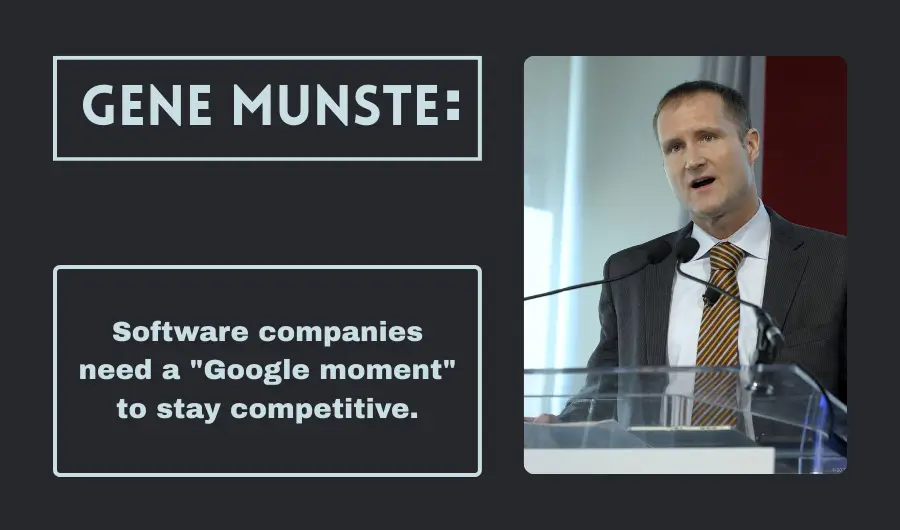
Gene Munster, managing partner at Deepwater Asset Management, stated industry software companies confronting artificial intelligence (AI) disruption must demonstrate a decisive strategic response akin to a “Google moment,” or risk diminished market relevance, according to recent commentary.
Munster’s remarks align with broader industry concerns over AI’s impact on traditional software business models, reflecting ongoing investor scrutiny in early 2026.
Munster Frames AI Disruption as Critical Inflection for Software Sector
In recent commentary captured by media outlets, veteran technology analyst Gene Munster articulated that established software companies face significant pressures from AI advancements that threaten conventional revenue structures and market positions. Citing trends in investor behavior and sector valuations, Munster emphasized that without a visible and large-scale strategic pivot—characterized metaphorically as a “Google moment”—software firms may struggle to maintain relevance amid accelerating AI-driven transformation.
Munster’s analysis reflects market unease over the pace at which generative and agent-based AI tools could disrupt traditional software licensing and workflow-centric products. Following pronounced sell-offs in software equities and increased scrutiny on earnings outlooks, the analyst highlighted that companies must not simply react defensively to AI challenges; they must adopt bold measures to integrate and monetize AI capabilities meaningfully. This perspective frames AI not merely as a technological enhancement but as a structural force reshaping long-standing commercial models across the sector.
Market Context: AI Disruption and Software Valuations
The broader software market has witnessed heightened volatility in 2026, with indices tracking software stocks down significantly amid concerns that AI agents may replicate or supplant core software functions. Recent industry reporting notes that cloud computing and software-as-a-service (SaaS) funds have seen steep declines in market value, in part due to fears that emergent AI tools could erode traditional revenue bases linked to per-seat licensing and other legacy models.
Against this backdrop, Munster’s framing of a “Google moment” refers to a decisive, capital-intensive strategic stance similar to moves made by large technology platforms such as Alphabet’s Google, which has substantially increased investment to integrate AI into core products and services. Such a pivot aims to reassure markets that a firm can leverage AI not only for product innovation but for monetizable outcomes that sustain competitive advantage. Market data indicate that major players executing substantial AI integration efforts—including cloud and search enhancements—have reported meaningful usage and backlog increases, highlighting potential pathways for firms seeking to weather disruption.
Implications for Software Business Models and Competitive Dynamics
Industry commentary reveals that the threat posed by AI is uneven across software categories. Commoditized workflow applications, particularly those with standardized pricing models, have faced severe investor pessimism as new AI agents demonstrate capabilities that could undercut traditional offerings. Conversely, firms with entrenched domain expertise, integrated data platforms, and resilient subscription revenue streams are perceived as better positioned to adapt and potentially thrive.
Analysts assert that the software landscape is fragmenting, with winners likely to emerge based on the depth of their AI integration, capital allocation strategies, and ability to align new capabilities with existing customer value propositions. This dynamic emphasizes that the disruption is not solely technological but deeply tied to strategic execution and business model evolution, reinforcing Munster’s call for a landmark strategic shift for software incumbents.
Investor Response and Sector Sentiment
Investor reaction to these structural factors has been pronounced, with broad sell-offs in software shares and increased rotation toward other segments of the technology market. Valuations across major software indices have adjusted sharply, reflecting a reassessment of growth prospects and risk premia associated with legacy business frameworks. Within this climate, commentary from analysts like Munster has resonated with institutional and retail market participants seeking clarity on which companies may successfully adapt versus those facing existential pressures.
The narrative emerging from sector analysis suggests that market participants are increasingly prioritizing evidence of AI monetization and tangible strategic commitments over defensive product enhancements. This shift in investor focus aligns with Munster’s argument that a definitive, high-impact strategic move is necessary to restore confidence and validate long-term relevance in a rapidly evolving technology landscape.
Sector Evolution and Strategic Expectations
Munster’s call for software firms to deliver a “Google moment” encapsulates a broader thematic in the technology industry: the need to transition from legacy models to AI-integrated paradigms that can sustain revenue growth and competitive moats. As the market continues to digest the implications of AI for enterprise software and platform economics, strategic execution will likely remain a focal point for corporate leadership and investor evaluation.
In this context, the software sector’s trajectory in 2026 and beyond will hinge on companies’ ability to validate their relevance through demonstrable, monetizable AI integration, consistent with the strategic narrative articulated by Gene Munster and reflected in market behavior.
AI Informed Newsletter
Stay informed on the fastest growing technology.
Disclaimer: The content on this page and all pages are for informational purposes only. We use AI to develop and improve our content — we love to use the tools we promote.
Course creators can promote their courses with us and AI apps Founders can get featured mentions on our website, send us an email.
Simplify AI use for the masses, enable anyone to leverage artificial intelligence for problem solving, building products and services that improves lives, creates wealth and advances economies.
A small group of researchers, educators and builders across AI, finance, media, digital assets and general technology.
If we have a shot at making life better, we owe it to ourselves to take it. Artificial intelligence (AI) brings us closer to abundance in health and wealth and we're committed to playing a role in bringing the use of this technology to the masses.
We aim to promote the use of AI as much as we can. In addition to courses, we will publish free prompts, guides and news, with the help of AI in research and content optimization.
We use cookies and other software to monitor and understand our web traffic to provide relevant contents, protection and promotions. To learn how our ad partners use your data, send us an email.
© newvon | all rights reserved | sitemap