

JP Morgan Sees AI Infrastructure Spending Reaching $1.4T by 2030 | News
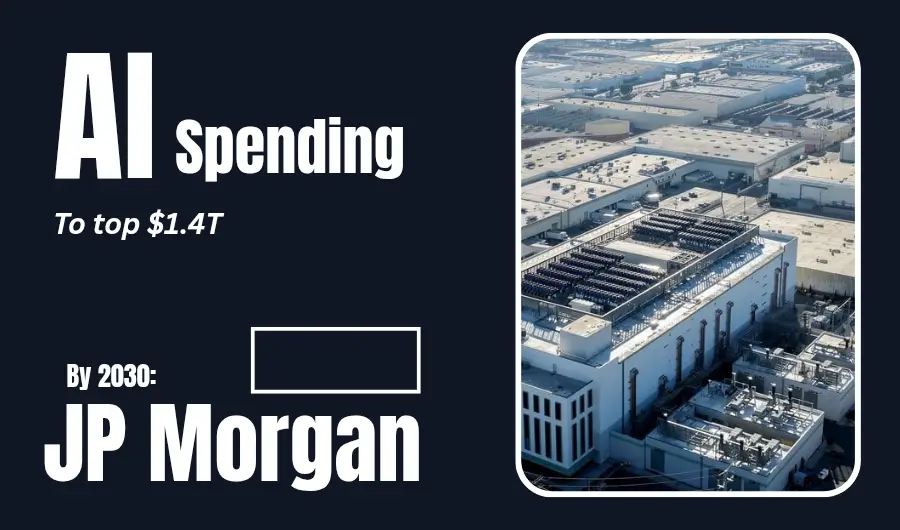
Analysts at JP Morgan have released projections indicating that global artificial intelligence (AI) infrastructure spending is on track to reach approximately $1.4 trillion per year by 2030, driven by rising demand for advanced data center technology, high performance hardware and processing capacity required to support AI workloads.
This forecast reflects a significant surge from current levels of infrastructure expenditure as enterprises, cloud providers and hyperscale operators expand their compute and storage capabilities to accommodate generative AI platforms, machine learning initiatives and increasingly complex data processing tasks.
JP Morgan’s outlook demonstrates the scale of the anticipated AI build out, projecting that capital expenditures (capex) associated with AI related data center expansion will dominate infrastructure budgets in the coming decade. This ramp up aligns with broader industry trends where technology developers and service providers are committing substantial resources to increase their AI processing capacity.
AI Data Centers and GPU Demand Trends
A central factor in the projected growth of AI infrastructure spending is the rising cost and deployment of graphics processing units (GPUs), which are widely recognized as the foundational components for advanced AI computing. According to the JP Morgan estimate, GPUs alone account for roughly 39% of the total AI data center infrastructure cost, reflecting their critical role in processing parallel tasks and training large AI models.
Industry data indicates that organizations are prioritizing high performance GPUs to support workloads ranging from generative AI to real time inference, reinforcing NVIDIA’s dominant position in the discrete GPU market. Market observers note that, despite increasing interest in alternatives such as application specific integrated circuits (ASICs) and tensor processing units (TPUs), GPUs remain the preferred solution due to their flexibility and widespread software support.
NVIDIA’s Market Position in AI Infrastructure
The JP Morgan forecast highlights NVIDIA as a key beneficiary of the growing AI infrastructure ecosystem, with the company commanding a significant share of the data center GPU market, estimated at about 92% based on recent industry figures. NVIDIA’s extensive ecosystem, including proprietary software frameworks and ongoing hardware innovation, has helped solidify its leadership in supplying the processing power required for cutting edge AI workloads.
NVIDIA’s advancements in GPU energy efficiency and computing performance, including improvements from its Blackwell generation chips and next generation architectures, play a central role in supporting large scale AI deployments across hyperscale data centers. These technological gains have helped NVIDIA maintain its competitive edge in a rapidly evolving compute landscape.
Capital Expenditure Drivers Across Tech Infrastructure
Beyond GPUs, the expansion of AI infrastructure encompasses a broad set of capital expenditure drivers.
These include networking hardware, specialized cooling systems, power distribution upgrades, and physical facility expansions necessary to house the next generation of high density compute clusters.
Collectively, these investments form the backbone of the data centers that underpin modern AI services.
Industry analysts note that the rapid evolution of generative AI and machine learning workloads has fundamentally altered enterprise infrastructure planning. Many large corporations and cloud service providers are investing heavily in new data center capacity, often years in advance of immediate demand, as part of long term strategic planning for AI enabled products and services.
Macro Trends Impacting AI Infrastructure Spending
The projected scale of AI infrastructure growth has macroeconomic implications for technology supply chains, real estate, energy consumption and broader industrial investment patterns. As AI compute requirements escalate, the demand for silicon, semiconductor fabrication capacity, power infrastructure and data center real estate has strengthened. These trends highlight the interconnected nature of the AI ecosystem and the far reaching effects of increased spending on compute infrastructure.
Analysts caution, however, that such rapid growth in capex may introduce volatility in related segments of the technology market, particularly as companies balance expansion plans with operational efficiency and return on investment considerations. Some industry observers point to potential supply constraints or cost inflation as variables that could influence long term expenditure trends.
Implications for Data Center Operators
The surge in AI infrastructure funding extends beyond chip manufacturers to include data center operators and service providers that supply the physical platforms and connectivity for AI compute clusters. Companies specializing in data center real estate and colocation services are positioned to benefit from heightened leasing activity as AI oriented firms seek additional capacity.
These operators are increasingly adapting their facilities to support high performance workloads, integrating optimized power delivery systems, advanced thermal management solutions and direct interconnection services that facilitate high speed data transfers across distributed compute environments.
Outlook and Industry Commentary
Industry projections for AI infrastructure growth to the $1.4 trillion annual expenditure level by 2030 reflect confidence in long term demand for AI enabled technology services and compute resources. JP Morgan’s forecast emphasizes the scale of infrastructure expansion required to meet future AI workload demands and highlights the centrality of GPUs and data center investment in shaping the technology landscape.
While uncertainties around the pace of adoption and competitive dynamics remain, the prevailing view among analysts is that AI infrastructure will continue to attract significant investment from both public and private sector actors in the years ahead. This continued investment reflects broader shifts toward cloud computing, distributed AI services and data intensive digital transformation initiatives across multiple industries.
AI Informed Newsletter
Stay informed on the fastest growing technology.
Disclaimer: The content on this page and all pages are for informational purposes only. We use AI to develop and improve our content — we love to use the tools we promote.
Course creators can promote their courses with us and AI apps Founders can get featured mentions on our website, send us an email.
Simplify AI use for the masses, enable anyone to leverage artificial intelligence for problem solving, building products and services that improves lives, creates wealth and advances economies.
A small group of researchers, educators and builders across AI, finance, media, digital assets and general technology.
If we have a shot at making life better, we owe it to ourselves to take it. Artificial intelligence (AI) brings us closer to abundance in health and wealth and we're committed to playing a role in bringing the use of this technology to the masses.
We aim to promote the use of AI as much as we can. In addition to courses, we will publish free prompts, guides and news, with the help of AI in research and content optimization.
We use cookies and other software to monitor and understand our web traffic to provide relevant contents, protection and promotions. To learn how our ad partners use your data, send us an email.
© newvon | all rights reserved | sitemap