

Nvidia CEO Says AI Boom Is Fueling Six-Figure Trade Jobs | News
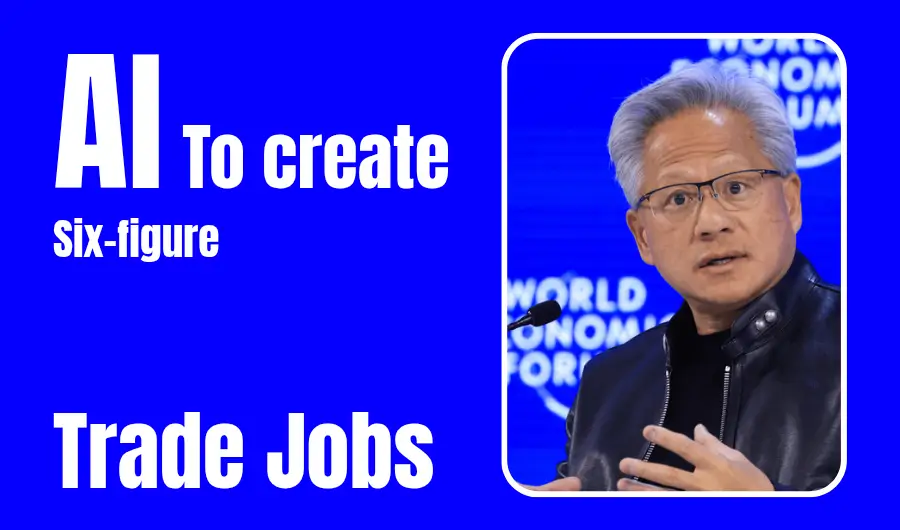
Artificial intelligence’s rapid expansion is reshaping global labor markets in unexpected ways, with Nvidia Chief Executive Officer Jensen Huang asserting that the ongoing buildout of AI infrastructure is generating high-paying employment opportunities in skilled trade roles previously not associated with six-figure wages.
Huang delivered his assessment Wednesday at the World Economic Forum in Davos, where leaders from business and finance gathered to discuss economic trends and technological disruption.
Speaking in conversation with BlackRock Chief Executive Larry Fink, Huang described what he called “the largest infrastructure build-out in human history” — a sweeping global effort to erect data centers, semiconductor facilities, and AI “factories.”
According to Huang, the complexity and scale of this buildout is driving unprecedented demand for hands-on labor, pushing traditional blue-collar jobs into high compensation brackets and narrowing the wage gap with many white-collar professions.
Huang said plumbers, electricians, construction workers, steelworkers and network technicians who help build and maintain these facilities are seeing salaries nearly double as companies compete for limited skilled labor. “We’re talking about six-figure salaries for people who are building chip factories or computer factories or AI factories,” he said. Huang added that such opportunities do not necessarily require advanced academic credentials, emphasising that “you don’t need to have a Ph.D. in computer science to do so.”
AI Infrastructure Demand Shifts Labor Dynamics
Huang’s remarks arrive amid broader debate about how artificial intelligence will affect jobs. While automation and AI tools have triggered layoffs in some sectors, the demand for physical infrastructure to support AI models, including power systems, cooling networks and complex hardware installations, is creating labor needs that existing workforces are struggling to fill.
This labor dynamic is particularly acute in skilled trades. According to Huang, companies racing to build data centers and AI facilities face shortages of trained workers capable of executing the physical construction and technical installations required. In many regions, wages for electricians, plumbers and construction professionals have increased sharply as firms compete for limited personnel.
Huang’s comments reflect a narrative echoed by other industry leaders in Davos, who have acknowledged that AI’s impact on labor extends beyond software and digital services into foundational physical systems. Some corporate executives see the expansion of AI infrastructure as a sustained source of employment growth, particularly in roles where human insight and manual skills remain difficult to automate.
Skilled Trades and Wage Growth
Reports from global news outlets covering Huang’s speech highlighted his emphasis on wage trends within manual labor sectors. In the United States and other markets, trade wages linked to AI buildouts are reportedly approaching or exceeding six-figure levels, a significant shift from historical perceptions of these roles’ earning potential.
Industry analysts point out that the construction of AI facilities, from data center campuses to chip fabrication plants, involves a wide variety of specialized work. Electrical systems, advanced plumbing for cooling infrastructure, steel framework, network installation and equipment fitting require trained personnel capable of performing tasks that automation cannot easily replicate. This complexity, combined with truncated supply of skilled workers, has contributed to rapid compensation increases.
In many regions, construction forecasting firms and industry sources report significant increases in data center spending and related construction activities, further adding pressure to an already competitive labor market for skilled trade professionals.
Broader Labor Market Concerns at Davos
Huang’s optimistic perspective on job creation in skilled trades stands alongside a broader and at times more cautious labor discourse at the World Economic Forum.
Some leaders at the forum highlighted concerns about AI’s potential to displace work in knowledge-based sectors. Critics worry that automation and advanced AI systems may reduce demand for traditional office and white-collar roles, especially ones that involve routine or repetitive tasks.
In contrast to Huang’s focus on opportunity, other business figures emphasized the need for strategies to support workers whose jobs could be disrupted by AI. Discussions at the forum included calls for increased retraining, wage support measures and collaborative efforts between governments and private sectors to cushion the transition for displaced employees.
The labor conversation at the forum also included commentary from other CEOs who, while recognising the expansion of vocational opportunities, warned of broader workforce vulnerabilities. Some have pointed to potential shortages of skilled workers unless educational and training systems adapt quickly to the changing employment landscape.
Opportunity Amid Disruption
Huang’s remarks highlight a complex and evolving picture of the AI economy: while automation may transform certain job categories, the physical infrastructure required to support powerful AI systems is driving demand for human labor in skilled trades at scale. This shift is drawing attention from policymakers, educators and industry leaders who view wage growth and employment opportunities in these sectors as part of a larger economic adjustment to AI-driven change.
The World Economic Forum continues through the week, bringing further discussions on technology, labor and economic policy to the global stage. Huang’s message that the AI buildout can create well-paid jobs in manual and technical fields is likely to shape ongoing dialogue about how economies adapt to the rapid rise of intelligent technologies.
AI Informed Newsletter
Stay informed on the fastest growing technology.
Disclaimer: The content on this page and all pages are for informational purposes only. We use AI to develop and improve our content — we love to use the tools we promote.
Course creators can promote their courses with us and AI apps Founders can get featured mentions on our website, send us an email.
Simplify AI use for the masses, enable anyone to leverage artificial intelligence for problem solving, building products and services that improves lives, creates wealth and advances economies.
A small group of researchers, educators and builders across AI, finance, media, digital assets and general technology.
If we have a shot at making life better, we owe it to ourselves to take it. Artificial intelligence (AI) brings us closer to abundance in health and wealth and we're committed to playing a role in bringing the use of this technology to the masses.
We aim to promote the use of AI as much as we can. In addition to courses, we will publish free prompts, guides and news, with the help of AI in research and content optimization.
We use cookies and other software to monitor and understand our web traffic to provide relevant contents, protection and promotions. To learn how our ad partners use your data, send us an email.
© newvon | all rights reserved | sitemap