

Nvidia Denies Rift With OpenAI, Affirms Major Investment
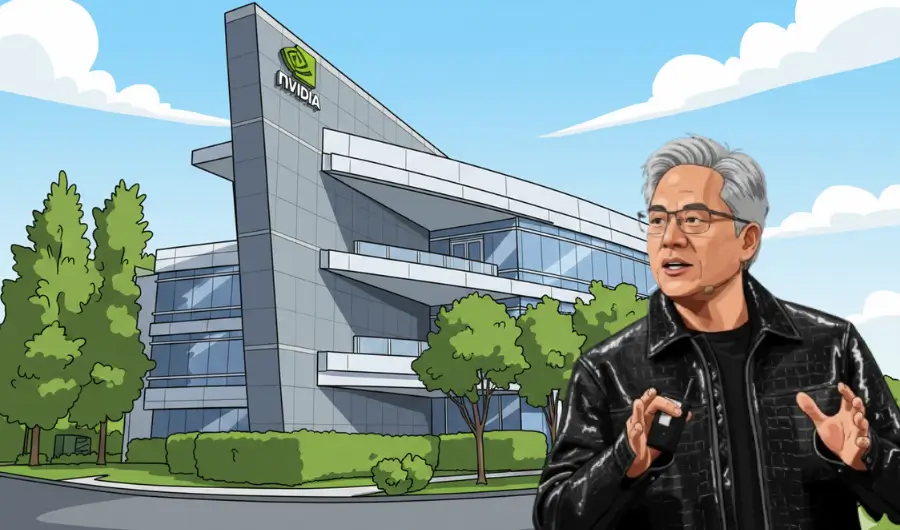
Nvidia Corp’s chief executive officer, Jensen Huang, publicly rejected recent claims that he was dissatisfied with the company’s relationship with OpenAI and affirmed Nvidia’s continued participation in a significant funding round for the artificial intelligence developer, citing a planned “huge” investment, remarks made in Taipei on January 31, 2026.
The statements followed a Wall Street Journal report that an earlier proposal for Nvidia to invest up to $100 billion in OpenAI had stalled amid internal discussion, prompting speculation about tension between the two companies.
Nvidia’s comments came during a media interaction outside a dinner event with key suppliers, where Huang addressed narratives suggesting friction between the chipmaker and one of its most important AI customers.
Nvidia had revealed in September 2025 that it intended to support OpenAI’s infrastructure expansion with up to $100 billion in investments tied to deployment of advanced computing systems, but recent reporting suggested portions of that plan were subject to debate within Nvidia’s leadership. Huang challenged characterizations that he was unhappy with OpenAI’s leadership or strategy, reiterated confidence in the partnership’s value, and confirmed that Nvidia would commit substantial capital likely to be its largest to date, though he indicated the final amount will be determined by OpenAI’s fundraising process.
Huang described the suggestion that he was unhappy with OpenAI as “nonsense,” emphasizing admiration for the work of OpenAI and its chief executive, Sam Altman.
He reiterated that Nvidia believes in OpenAI’s technological contributions and that the company will participate in its current financing round, which Altman is overseeing. Huang clarified that while the original $100 billion figure represented the scale of the opportunity envisioned, the eventual investment would not approach that number and would instead align with the needs of the specific fundraising round.
The Wall Street Journal’s report, which preceded Huang’s remarks, said Nvidia executives had privately indicated that the earlier non-binding intention to invest up to $100 billion had not been finalised and that some within Nvidia had expressed concerns about aspects of OpenAI’s business discipline and competitiveness amid rising rivalries with other AI developers, including Alphabet’s Google and Anthropic. Nvidia did not publicly confirm internal discussions but responded to characterisations of the partnership’s status through Huang’s statements.
Industry reporting highlights the size and complexity of the relationship between Nvidia and OpenAI. The September 2025 memorandum of understanding envisaged Nvidia supporting OpenAI’s deployment of at least 10 gigawatts of computing infrastructure powered by Nvidia systems, integral to the training and operation of large generative models. That agreement, unexecuted as a definitive contract, was positioned as central to OpenAI’s strategic expansion and Nvidia’s AI ecosystem leadership, while also drawing regulatory and competitive scrutiny from market observers.
Huang’s remarks align with his efforts to contextualise Nvidia’s investment approach as strategic and measured. In clarifying that the up to $100 billion projection was non-binding and subject to individual funding rounds, he framed the company’s participation as conditional and adaptive to OpenAI’s fundraising trajectory, distancing Nvidia from fixed commitments. This distinction reflects broader market dynamics in which large capital outlays for artificial intelligence (AI) infrastructure are negotiated incrementally and often involve multiple investors and stakeholders.
Beyond Nvidia’s relationship with OpenAI, the AI hardware and software market has expanded rapidly, with Nvidia’s graphics processing units (GPUs) central to training and serving large language models and other advanced AI systems.
Nvidia’s dominance in AI computing has underpinned its market valuation and revenue growth, even as competitors seek to develop alternative solutions and custom silicon for large-scale AI workloads. OpenAI’s demand for high-performance computing resources has made it one of Nvidia’s most significant customers, alongside cloud providers and enterprise adopters of generative AI services.
Financial analysts and media outlets have also highlighted that Nvidia’s proposed involvement in OpenAI’s funding round is among several large-scale investments being considered in the broader AI ecosystem, with other major technology companies reportedly exploring substantial contributions to OpenAI’s capital raising. These discussions reflect the significant capital requirements associated with building and operating data centres capable of supporting next-generation AI models while balancing competitive pressures across the sector.
Huang’s public rejection of narratives suggesting a rift with OpenAI was delivered in the context of industry speculation about the pace and scale of the AI investment climate. Reports that Nvidia might reduce its planned investment had triggered market commentary on the future of the partnership and the implications for both companies, given their intertwined roles in advancing artificial intelligence capabilities. By reaffirming Nvidia’s commitment to participate substantively in the funding round and expressing confidence in OpenAI’s work, Huang sought to clarify Nvidia’s strategic position and support for collaborative growth in AI infrastructure.
AI Informed Newsletter
Stay informed on the fastest growing technology.
Disclaimer: The content on this page and all pages are for informational purposes only. We use AI to develop and improve our content — we love to use the tools we promote.
Course creators can promote their courses with us and AI apps Founders can get featured mentions on our website, send us an email.
Simplify AI use for the masses, enable anyone to leverage artificial intelligence for problem solving, building products and services that improves lives, creates wealth and advances economies.
A small group of researchers, educators and builders across AI, finance, media, digital assets and general technology.
If we have a shot at making life better, we owe it to ourselves to take it. Artificial intelligence (AI) brings us closer to abundance in health and wealth and we're committed to playing a role in bringing the use of this technology to the masses.
We aim to promote the use of AI as much as we can. In addition to courses, we will publish free prompts, guides and news, with the help of AI in research and content optimization.
We use cookies and other software to monitor and understand our web traffic to provide relevant contents, protection and promotions. To learn how our ad partners use your data, send us an email.
© newvon | all rights reserved | sitemap