

Tesla Ends Model S & X Production, Focuses on Robotaxi and Robotics
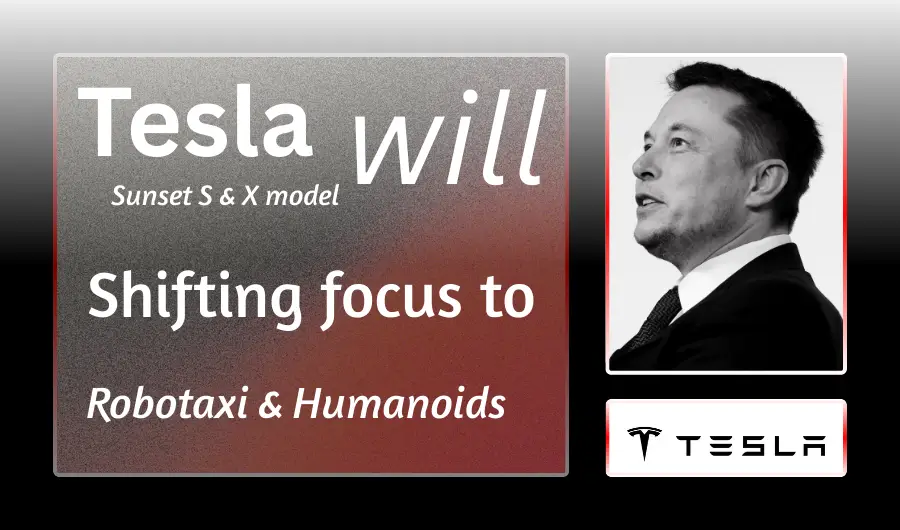
Tesla Inc. will discontinue production of its Model S sedan and Model X SUV in the second quarter of 2026, redirecting manufacturing capacity and capital toward autonomous robotaxi services and humanoid robot production, Chief Executive Officer Elon Musk announced during the company’s fourth-quarter 2025 earnings call. The shift reflects a strategic reallocation of resources as Tesla expands its investments in artificial intelligence-driven products, including Optimus humanoid robots and fully autonomous Cybercab vehicles.
Tesla’s executive leadership confirmed that production of the long-running Model S and Model X vehicles, once flagship offerings in the company’s portfolio, will wind down next quarter. The decision is part of a broader plan to convert existing assembly operations at the Fremont, California factory into production lines for robotaxis and Tesla’s Optimus humanoid robots, with ambitions to achieve significant scaling of these new product categories.
The Model S, introduced in 2012, and the Model X, launched in 2015, played foundational roles in Tesla’s emergence as a major electric vehicle manufacturer. However, recent sales figures show a marked decline in demand for these models relative to Tesla’s mass-market offerings. In 2025, deliveries of the Model 3 and Model Y accounted for the overwhelming majority of the company’s deliveries, while sales volumes for the “other” category, which includes Model S and Model X among others, fell sharply.
This corporate pivot accompanies robust expansion in Tesla’s capital expenditure plans. The company has indicated it will more than double its 2026 planned capital spending to approximately $20 billion, reallocating financial resources toward autonomous vehicle technologies, robotics manufacturing, energy storage, batteries, and artificial intelligence initiatives. Tesla reported that paid Full Self-Driving subscribers grew year-on-year, with over 1.1 million subscribers and roughly 500 robotaxis operating in select U.S. markets, and additional markets slated for expansion in 2026.
Musk characterized the discontinuation of the Model S and Model X programs as an “honorable discharge,” highlighting the company’s commitment to what it views as a software and autonomy-centric future. Once current inventory is sold, Tesla will not resume production of these vehicles, although the company has pledged to continue supporting existing owners with service and parts for as long as their vehicles remain in use.
The transition comes amid broader challenges in Tesla’s automotive segment. The company recorded its first annual decline in total revenue in 2025, with automotive revenue falling year-on-year alongside reduced deliveries. Market conditions, including increased competition from other electric vehicle makers, have contributed to this dynamic. Chinese automaker BYD, for example, surpassed Tesla in global battery electric vehicle sales for the 2025 calendar year.
Tesla’s Optimus humanoid robot program, first unveiled in prototype form in 2022, is central to the company’s robotics strategy. Tesla aims to begin mass production of the next-generation Optimus model before the end of 2026, with a long-term production target of up to one million units annually in the retooled Fremont facility. The initiative is positioned alongside Tesla’s development of autonomous robotaxis, including the Cybercab, which the company expects to commence production in 2026 and to deploy across additional regions.
Industry analysts and observers have noted that the move signifies a definitive shift in Tesla’s identity from traditional automotive manufacturer toward an enterprise focused on robotics and autonomous technologies. While the Model 3 and Model Y continue to account for the bulk of vehicle sales, Tesla’s strategic reorientation places increased emphasis on physical artificial intelligence and software-driven mobility services as core elements of its growth strategy.
AI Informed Newsletter
Stay informed on the fastest growing technology.
Disclaimer: The content on this page and all pages are for informational purposes only. We use AI to develop and improve our content — we love to use the tools we promote.
Course creators can promote their courses with us and AI apps Founders can get featured mentions on our website, send us an email.
Simplify AI use for the masses, enable anyone to leverage artificial intelligence for problem solving, building products and services that improves lives, creates wealth and advances economies.
A small group of researchers, educators and builders across AI, finance, media, digital assets and general technology.
If we have a shot at making life better, we owe it to ourselves to take it. Artificial intelligence (AI) brings us closer to abundance in health and wealth and we're committed to playing a role in bringing the use of this technology to the masses.
We aim to promote the use of AI as much as we can. In addition to courses, we will publish free prompts, guides and news, with the help of AI in research and content optimization.
We use cookies and other software to monitor and understand our web traffic to provide relevant contents, protection and promotions. To learn how our ad partners use your data, send us an email.
© newvon | all rights reserved | sitemap