

What is AI marketing?
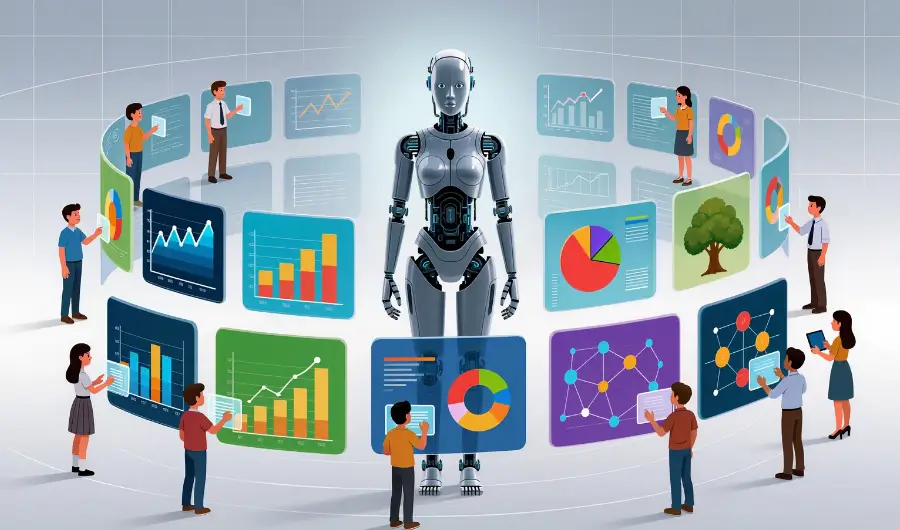
AI marketing is one of those phrases that sounds both exciting and intimidating at the same time.
You hear it everywhere: companies saying they use AI to understand customers, tools promising to automate your marketing, and experts claiming it will change how businesses grow forever.
For many people, especially non-technical learners, it can feel vague, overhyped, or even confusing. Is AI marketing just another buzzword? Is it only for big companies with huge budgets? Or is it something practical that actually helps marketers make better decisions?
At its core, AI marketing is not magic, and it is not a replacement for human creativity or strategy. It is a way of using machines to notice patterns, make predictions, and support marketing decisions at a scale and speed that humans alone cannot manage.
When explained clearly, AI marketing becomes much easier to understand. It is less about robots taking over and more about tools that help marketers listen better, respond faster, and communicate more personally with their audiences.
What Do We Mean by “AI” in AI Marketing?
Before we talk about AI marketing, we need to understand what “AI” actually means in this context.
Artificial Intelligence, often shortened to AI, is a broad term used to describe computer systems that can perform tasks that usually require human thinking. These tasks include recognizing patterns, understanding language, learning from experience, and making decisions based on data.
In marketing, AI does not mean a computer that thinks or feels like a human. Instead, it refers to software that has been trained on large amounts of information so it can find useful patterns. For example, an AI system might learn what kinds of emails people tend to open, which products are often bought together, or what type of message works best at different times of day.
A helpful way to think about AI in marketing is as an extremely fast and tireless assistant. It does not get bored, it does not forget details, and it can look at millions of data points at once. However, it does not understand meaning or emotion the way humans do. It works based on probabilities and examples, not intuition or empathy. This distinction is important because it helps set realistic expectations.
What Is Marketing, Stripped to Its Basics?
To understand AI marketing fully, we also need to step back and define marketing itself. At its simplest level, marketing is about understanding people and communicating value. It involves learning who your audience is, what they care about, what problems they are trying to solve, and how your product or service fits into their lives.
Marketing includes many activities: research, branding, advertising, content creation, customer communication, pricing, and distribution. All of these activities rely on decisions. What message should we send? To whom? When? Through which channel? At what cost? Traditionally, marketers answered these questions using experience, intuition, surveys, and limited data.
AI marketing enters the picture by helping answer these same questions using much larger amounts of information and more consistent analysis. It does not change the goals of marketing. Instead, it changes how those goals are achieved.
Defining AI Marketing Clearly
AI marketing is the use of artificial intelligence tools and systems to help marketers understand customers, plan campaigns, create content, personalize experiences, and measure results more effectively. It involves using machines to analyze data, predict outcomes, and automate certain marketing tasks.
A key word here is “help.” AI marketing supports human marketers rather than replacing them. It can suggest what might work best, highlight opportunities, and handle repetitive tasks. Humans still set the goals, define the brand voice, make ethical decisions, and apply judgment.
Another important aspect of AI marketing is learning over time. Many AI systems improve as they process more information. For example, a recommendation system may start with basic suggestions and gradually become more accurate as it learns what customers actually respond to.
Why AI Marketing Exists in the First Place
AI marketing did not appear out of nowhere. It exists because modern marketing has become incredibly complex. People interact with brands across many platforms: websites, social media, email, messaging apps, and physical stores. Each interaction creates data. For humans alone, it is almost impossible to analyze all of this information in real time.
At the same time, customers now expect more relevant and timely experiences. They do not want generic messages. They want content that feels personal, useful, and respectful of their time. AI helps bridge this gap by making sense of large amounts of data and turning it into actionable insights.
In simple terms, AI marketing exists because there is too much information for humans to handle alone, and because expectations for personalization and speed are higher than ever.
How AI Marketing Actually Works
AI marketing systems usually follow a simple cycle. First, they collect data. This data can include website visits, email clicks, purchase history, search behavior, and customer feedback. Second, they analyze this data to find patterns. For example, they might notice that people who read certain blog posts are more likely to buy a specific product.
Third, the system uses these patterns to make predictions or suggestions. It might predict which customers are likely to leave, which products someone might be interested in, or what time is best to send a message. Finally, these insights are used to take action, either automatically or with human approval.
The important thing to understand is that AI marketing does not “understand” customers in a human sense. It recognizes statistical patterns. When used thoughtfully, these patterns can be extremely useful. When used blindly, they can lead to mistakes.
Common Areas Where AI Is Used in Marketing
AI marketing shows up in many everyday tools, often without users realizing it. Email platforms use AI to suggest subject lines or predict the best time to send messages. Online stores use AI to recommend products based on browsing and purchase history. Advertising platforms use AI to decide which ads to show to which people.
Content creation is another growing area. AI tools can help generate ideas, write drafts, summarize information, or adapt messages for different audiences. Customer support often uses AI-powered chat systems to answer common questions quickly. Analytics tools use AI to highlight trends and anomalies that might otherwise go unnoticed.
These applications differ in complexity, but they all share the same goal: making marketing more efficient, more relevant, and more measurable.
Personalization: One of the Biggest Promises of AI Marketing
Personalization is often described as the heart of AI marketing. It means tailoring messages, offers, and experiences to individual people rather than treating everyone the same. AI makes personalization possible at scale by automatically adjusting content based on data.
For example, two people visiting the same website might see different product recommendations, headlines, or images based on their past behavior. An email campaign might automatically adjust its content depending on the recipient’s interests. This level of customization would be impossible to manage manually for thousands or millions of users.
However, personalization must be handled carefully. When done well, it feels helpful. When done poorly, it can feel invasive. Understanding this balance is a key part of responsible AI marketing.
Automation vs. Intelligence: An Important Distinction
One common misunderstanding is that any automated marketing is AI marketing. Automation simply means using software to perform tasks automatically, such as sending scheduled emails. AI marketing goes a step further by using learning and prediction.
For example, sending the same email to everyone at a fixed time is automation. Using a system that decides the best time for each individual recipient based on past behavior involves AI. The difference lies in adaptation and learning.
Recognizing this distinction helps marketers choose tools wisely and avoid being misled by exaggerated claims.
What AI Marketing Is Not
AI marketing is not a shortcut to instant success. It does not eliminate the need for strategy, creativity, or ethical thinking. It is not a replacement for understanding your audience deeply. It also does not guarantee better results if the underlying data is poor or biased.
It is also not only for large corporations. While big companies may have more data, smaller businesses can still benefit from AI tools designed for accessibility and ease of use.
Benefits of AI Marketing
When implemented thoughtfully, AI marketing can save time, reduce guesswork, improve targeting, and help teams focus on higher-level work. It can uncover insights that humans might miss and enable more consistent decision-making.
It can also help businesses respond more quickly to changes in customer behavior, which is increasingly important in fast-moving markets.
The Human Role in AI Marketing
Despite all the technology involved, humans remain central to AI marketing. Humans define goals, interpret results, and ensure that marketing remains respectful and meaningful. AI is a tool, not a leader.
The most successful AI marketing strategies combine machine efficiency with human judgment and creativity.
The Future of AI Marketing
As AI tools become more accessible and more powerful, AI marketing will likely become a standard part of marketing practice rather than a special category. The focus will shift from whether to use AI to how to use it responsibly and effectively.
Understanding AI marketing today prepares marketers not just to use tools, but to think critically about how technology shapes communication.
Conclusion
AI marketing is best understood as a supportive layer added to traditional marketing, not a replacement for it. It helps marketers see patterns, act faster, and personalize experiences at scale.
By grounding AI marketing in human goals and values, marketers can use it to build better relationships rather than just more efficient systems. That is what AI marketing truly is: a set of tools that, when used wisely, helps marketing become more thoughtful, not less.
AI Informed Newsletter
Stay informed on the fastest growing technology.
Disclaimer: The content on this page and all pages are for informational purposes only. We use AI to develop and improve our content — we love to use the tools we promote.
Course creators can promote their courses with us and AI apps Founders can get featured mentions on our website, send us an email.
Simplify AI use for the masses, enable anyone to leverage artificial intelligence for problem solving, building products and services that improves lives, creates wealth and advances economies.
A small group of researchers, educators and builders across AI, finance, media, digital assets and general technology.
If we have a shot at making life better, we owe it to ourselves to take it. Artificial intelligence (AI) brings us closer to abundance in health and wealth and we're committed to playing a role in bringing the use of this technology to the masses.
We aim to promote the use of AI as much as we can. In addition to courses, we will publish free prompts, guides and news, with the help of AI in research and content optimization.
We use cookies and other software to monitor and understand our web traffic to provide relevant contents, protection and promotions. To learn how our ad partners use your data, send us an email.
© newvon | all rights reserved | sitemap