

What is AI Memory?
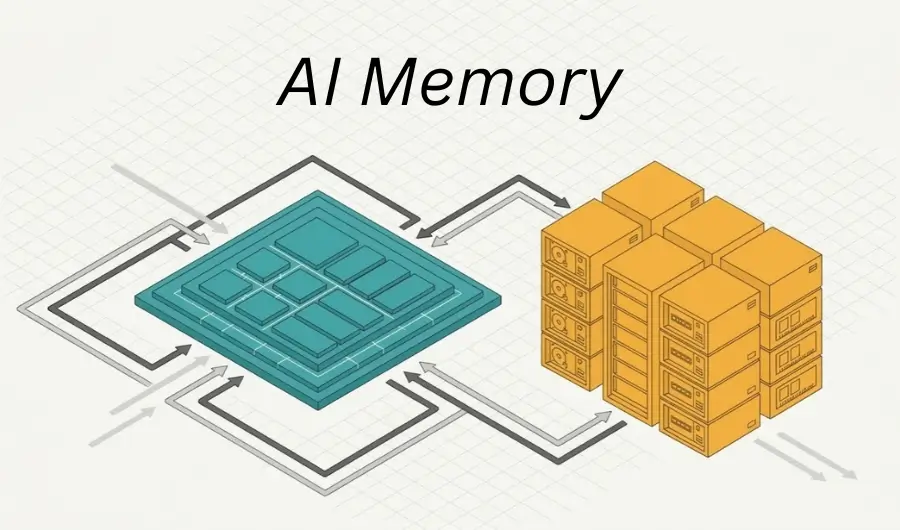
AI memory is the capability of an artificial intelligence system to store, retrieve, and use past information to influence future processing and decision-making.
Defining AI Memory in Artificial Intelligence Systems
AI memory refers to the mechanisms that allow an artificial intelligence system to retain information beyond a single computational step and use that retained information during subsequent processing. In machine learning and intelligent systems, memory provides continuity between inputs, enabling models to recognize patterns across time, maintain contextual awareness, and adapt responses based on previous data.
Unlike traditional program variables that exist only during immediate execution, AI memory is typically designed to preserve representations of data, internal states, or learned parameters across tasks. These representations can exist within the architecture of a model itself or within external storage systems that the model can access during inference or training.
The presence of memory allows AI systems to move beyond purely stateless computation. Instead of processing each input independently, systems with memory can incorporate contextual signals derived from prior inputs, previous interactions, or stored knowledge. This capability is essential for tasks such as natural language understanding, sequential prediction, planning, and reasoning.
Architectural Foundations of AI Memory
In modern artificial intelligence architectures, memory can be implemented through both internal model structures and external storage frameworks. Internal memory is embedded directly within the computational architecture of a model and often manifests as learned parameters or persistent state vectors that influence future outputs.
One of the earliest widely recognized examples of internal memory appears in recurrent neural networks. Research by Sepp Hochreiter and Jürgen Schmidhuber at the Technical University of Munich introduced Long Short-Term Memory (LSTM) networks in 1997 to address the problem of retaining information across long sequences. LSTM architectures use gated mechanisms that regulate how information enters, persists within, and exits the network’s memory cells. These gates allow the model to maintain relevant information over extended time intervals while discarding less useful signals.
Later neural architectures expanded the concept of internal memory further. Transformer models, introduced in the 2017 paper “Attention Is All You Need” by researchers at Google, rely on attention mechanisms that store contextual relationships between tokens within a sequence. Although transformer models do not maintain memory in the recurrent sense, they preserve contextual representations within attention layers during inference, allowing them to track relationships across long passages of text.
These architectural innovations demonstrate that AI memory can emerge as a structural property of the model itself, enabling persistent information flow across computation steps.
Short-Term and Long-Term Memory in AI Systems
AI memory is often conceptually divided into short-term and long-term forms, reflecting different temporal scopes of information retention.
Short-term memory in AI refers to temporary contextual storage that exists during the processing of a particular input sequence or interaction. In transformer-based language models such as those developed by OpenAI, contextual memory exists within the model’s attention window, where tokens earlier in the sequence influence the interpretation of later tokens. This form of memory is limited by computational constraints, meaning the system can only maintain context within a defined window of input data.
Long-term memory, by contrast, involves mechanisms that allow an AI system to retain information beyond a single interaction or computational cycle. Long-term memory may be implemented through persistent knowledge bases, external databases, or embedding stores that preserve learned information over extended periods. For example, knowledge graphs used in large-scale AI systems, such as the Google Knowledge Graph, function as long-term memory structures that store structured relationships between entities.
The distinction between short-term and long-term memory mirrors concepts from cognitive science, but in artificial intelligence the separation is primarily technical rather than biological. Short-term memory is constrained by computational architecture, while long-term memory depends on external storage and retrieval mechanisms.
External Memory Systems and Retrieval Mechanisms
As AI models have grown larger and more capable, researchers have increasingly integrated external memory systems to extend the knowledge capacity of machine learning models. These systems store information outside the core neural architecture while providing mechanisms for dynamic retrieval during processing.
One influential research direction is the development of differentiable memory systems. The Neural Turing Machine, introduced in 2014 by researchers at DeepMind, combines a neural network controller with an external memory matrix that can be read from and written to using differentiable operations. This architecture allows the system to learn how to store and retrieve information during training, effectively giving the neural network an addressable memory structure similar to that of a conventional computer.
Another widely adopted approach is retrieval-augmented generation. In 2020, researchers at Facebook AI Research (now Meta AI) introduced Retrieval-Augmented Generation (RAG), a framework that integrates a neural language model with a document retrieval system. When generating responses, the model queries an external knowledge database and incorporates retrieved documents into the generation process. This method allows the system to access information that may not be encoded directly within the model’s parameters.
External memory systems address a key limitation of large neural models. While parameters can encode vast amounts of statistical knowledge, they cannot efficiently store detailed factual data at the scale of global information systems. External memory provides a scalable solution by separating knowledge storage from the neural reasoning process.
Memory in Reinforcement Learning Systems
AI memory also plays a critical role in reinforcement learning, where agents must learn optimal strategies through repeated interaction with an environment. In these systems, memory enables the agent to incorporate historical observations into decision-making.
Deep reinforcement learning research conducted by DeepMind has demonstrated the importance of memory in partially observable environments. In such environments, the agent cannot observe the full state of the system at any given moment, meaning that historical information is required to infer hidden variables. Recurrent neural networks and memory-augmented architectures allow reinforcement learning agents to maintain internal state representations that capture information about previous observations.
This capability is essential in complex tasks where optimal decisions depend on sequences of events rather than isolated observations. Memory therefore functions as a mechanism for temporal reasoning, enabling agents to connect past experience with present action selection.
Memory Management and Computational Constraints
Despite its importance, AI memory introduces significant computational challenges. Memory mechanisms require storage capacity, retrieval algorithms, and efficient methods for selecting relevant information during processing. As models scale, managing these resources becomes increasingly complex.
One challenge involves maintaining relevant context without overwhelming the model with irrelevant data. Attention mechanisms in transformer architectures partially address this issue by weighting the importance of different tokens within a sequence. However, the computational cost of attention grows with sequence length, limiting how much contextual information can be processed simultaneously.
Another challenge arises in long-term memory systems that rely on external databases or vector embeddings. Retrieval mechanisms must efficiently identify relevant information among potentially billions of stored entries. Modern AI systems often rely on approximate nearest neighbor search algorithms, such as those implemented in vector databases developed by companies like Pinecone or Weaviate, to enable scalable memory retrieval.
These engineering constraints highlight that AI memory is not only a conceptual capability but also a systems design problem involving storage architecture, indexing methods, and retrieval efficiency.
Distinguishing AI Memory From Model Parameters
It is important to distinguish AI memory from the learned parameters of a machine learning model. Model parameters, such as the weights of a neural network, encode statistical relationships learned during training. These parameters allow the model to generalize patterns from training data but do not function as explicit memory structures.
AI memory, in contrast, refers to mechanisms that store information in a way that can be directly retrieved or updated during operation. While parameters represent distributed knowledge embedded within the model’s structure, memory systems provide explicit access to stored information that can influence processing in real time.
This distinction becomes especially relevant in modern AI system design, where developers increasingly combine pretrained neural models with external memory systems. In such architectures, parameters provide general reasoning capability while memory stores factual or contextual data that may change over time.
The Role of Memory in Advanced AI Capabilities
Memory is a foundational component of advanced artificial intelligence because many intelligent behaviors require the ability to accumulate and reference information across time. Tasks such as dialogue systems, planning algorithms, and long-horizon decision-making depend on persistent representations of prior events.
Large language models, reinforcement learning agents, and hybrid neural-symbolic systems all rely on memory mechanisms to maintain contextual continuity. Without memory, AI systems would process each input independently, preventing them from recognizing temporal patterns, maintaining conversational context, or learning from experience.
For this reason, ongoing research in artificial intelligence continues to explore new memory architectures that combine neural computation with scalable knowledge storage. Developments in differentiable memory, retrieval-augmented systems, and vector databases indicate that the evolution of AI memory will remain closely tied to the broader progress of intelligent system design.
AI memory enables machines to connect past data with present computation. This ability transforms artificial intelligence from a purely reactive system into one capable of contextual reasoning, sequential learning, and persistent knowledge integration.
AI Informed Newsletter
Stay informed on the fastest growing technology.
Disclaimer: The content on this page and all pages are for informational purposes only. We use AI to develop and improve our content — we love to use the tools we promote.
Course creators can promote their courses with us and AI apps Founders can get featured mentions on our website, send us an email.
Simplify AI use for the masses, enable anyone to leverage artificial intelligence for problem solving, building products and services that improves lives, creates wealth and advances economies.
A small group of researchers, educators and builders across AI, finance, media, digital assets and general technology.
If we have a shot at making life better, we owe it to ourselves to take it. Artificial intelligence (AI) brings us closer to abundance in health and wealth and we're committed to playing a role in bringing the use of this technology to the masses.
We aim to promote the use of AI as much as we can. In addition to courses, we will publish free prompts, guides and news, with the help of AI in research and content optimization.
We use cookies and other software to monitor and understand our web traffic to provide relevant contents, protection and promotions. To learn how our ad partners use your data, send us an email.
© newvon | all rights reserved | sitemap