

Will AI replace Graphics Designers?
AI is transforming graphic design workflows, but full replacement of human designers remains technically and economically unlikely.
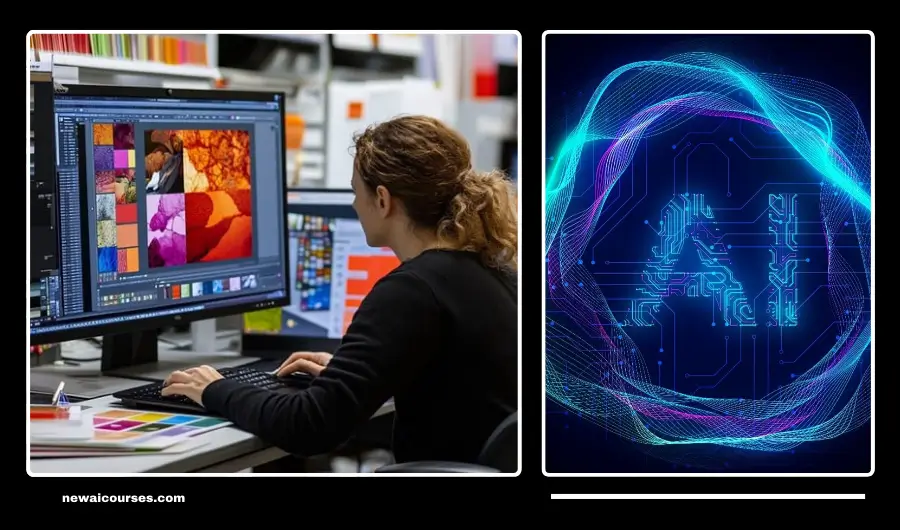
The Role of Graphic Designers in Visual Communication
Graphic design is a multidisciplinary practice that combines visual composition, communication theory, typography, color science, and digital production workflows to convey information and meaning. Professional graphic designers do more than generate images; they interpret business objectives, audience psychology, and brand identity constraints to produce coherent visual systems. This process typically involves iterative conceptual development, stakeholder feedback cycles, and alignment with marketing or product strategies.
Modern design work also requires technical fluency in layout systems, vector and raster workflows, and cross-platform asset optimization. Tools such as those developed by Adobe, including industry-standard applications like Adobe Photoshop, are used not only for image creation but also for structured production pipelines spanning print, web, and motion graphics. Because of this layered workflow, evaluating whether artificial intelligence can replace graphic designers requires separating automated visual generation from full design problem-solving.
How AI Image Generation Systems Work
AI-driven image generation is primarily built on deep learning architectures known as diffusion models and transformer-based multimodal systems. Platforms created by organizations such as OpenAI and Stability AI have demonstrated that large-scale training on image-text datasets enables systems to generate original visuals from natural language prompts.
Systems including DALL·E and Stable Diffusion operate by learning statistical relationships between visual structures and semantic descriptions. During generation, the model iteratively removes noise from a randomized latent representation to produce an image aligned with the prompt. These systems can replicate stylistic patterns, simulate lighting conditions, and produce high-resolution compositions within seconds, dramatically reducing the time required for concept exploration.
Another widely used platform, Midjourney, demonstrates how generative systems can produce visually sophisticated outputs with minimal technical input. This capability has accelerated adoption across marketing teams and independent creators who previously relied on manual illustration workflows.
AI Integration Into Professional Design Tools
Rather than replacing designers outright, AI is increasingly being integrated into existing design ecosystems. For example, Adobe Firefly embeds generative features directly into production workflows, allowing users to perform tasks such as generative fill, style transfer, and automated asset variations inside established design interfaces.
Similarly, Canva has incorporated AI-assisted layout generation and text-to-image capabilities to simplify content creation for non-specialists. These integrations demonstrate a clear industry trend: AI is being positioned as a productivity layer rather than a full replacement mechanism.
From a technical perspective, AI performs best in bounded visual tasks where constraints are explicit and measurable. Automated background removal, color palette generation, and layout suggestions rely on pattern recognition rather than conceptual reasoning. When design problems require interpretation of ambiguous business goals or cultural context, current AI systems still depend heavily on human direction.
Where AI Is Replacing Specific Design Tasks
Artificial intelligence is already replacing certain categories of production-level design work, particularly repetitive or low-complexity tasks. Social media asset generation, background editing, template adaptation, and rapid concept visualization are increasingly automated through generative workflows.
This shift is largely driven by computational efficiency. Tasks that previously required manual layer manipulation or iterative asset exports can now be completed through prompt-driven generation. Organizations with high-volume content pipelines, such as digital marketing teams, benefit from reduced turnaround times and lower production costs.
However, the replacement effect is uneven across the design profession. Entry-level production roles are more exposed because they often involve standardized workflows with predictable outputs. In contrast, senior-level design roles typically include strategic responsibilities that extend beyond visual generation.
Why AI Cannot Fully Replace Graphic Designers
Despite rapid advances in generative modeling, several technical and practical constraints limit full automation of graphic design. One major limitation is the absence of true semantic understanding. AI models generate outputs based on statistical correlations rather than intentional communication design. While a model can approximate a visual style, it does not inherently understand brand positioning or audience interpretation.
Another limitation involves iterative stakeholder collaboration. Professional design processes often include evolving requirements, subjective feedback, and cross-functional alignment. These interactions require contextual reasoning and negotiation skills that current AI systems do not possess.
Copyright and dataset governance also introduce constraints. Many generative systems are trained on large-scale scraped datasets, which has led to legal scrutiny regarding training data provenance. This affects how generated assets can be used commercially and reinforces the need for human oversight in professional environments.
Furthermore, consistency across long-term visual systems remains a challenge for generative models. Brand identity frameworks require strict adherence to typography hierarchies, spacing systems, and asset reuse structures. Maintaining this consistency across multiple campaigns typically requires structured design systems managed by human designers.
The Shift From Creation to Direction
The practical impact of AI is changing the role of graphic designers rather than eliminating it. Designers are increasingly acting as creative directors of AI-assisted workflows, defining prompts, refining outputs, and integrating generated visuals into structured design systems.
This shift mirrors earlier technological transitions in the design industry. The adoption of digital layout tools in the 1990s did not eliminate designers but instead transformed production processes. AI is producing a similar transformation by automating mechanical tasks while increasing the importance of conceptual oversight.
Designers who understand prompt engineering, generative constraints, and hybrid workflows are positioned to benefit from AI integration. The technical skill set is expanding to include model interaction and output validation alongside traditional visual composition expertise.
Economic and Industry Outlook
Current adoption patterns indicate augmentation rather than full displacement. Businesses are implementing AI tools to increase output scale, but they continue to rely on designers for brand control, campaign coherence, and strategic direction. This aligns with the broader pattern observed across automation technologies, where task-level automation occurs faster than occupation-level replacement.
Generative AI is also creating new categories of design work. Asset curation, AI output refinement, dataset preparation, and style consistency management are emerging responsibilities within design teams. These functions require both technical literacy and visual judgment, reinforcing the continued relevance of human designers.
The economic outcome therefore depends on skill adaptation. Designers focused solely on production execution face greater automation exposure, while those operating at conceptual and strategic levels remain difficult to replace.
Conclusion
Artificial intelligence is significantly reshaping graphic design workflows, particularly in rapid asset generation and production automation. Systems developed by organizations such as OpenAI, Stability AI, Adobe, Canva, and Midjourney demonstrate that visual generation can now be performed at scale with minimal manual input. However, graphic design as a discipline extends beyond image creation into communication strategy, brand architecture, and collaborative problem-solving.
Because current AI models lack contextual reasoning, stakeholder interpretation, and long-term visual system management, full replacement of graphic designers remains unlikely. The more realistic trajectory is role transformation, where designers increasingly direct AI systems rather than compete with them.
AI Informed Newsletter
Stay informed on the fastest growing technology.
Disclaimer: The content on this page and all pages are for informational purposes only. We use AI to develop and improve our content — we love to use the tools we promote.
Course creators can promote their courses with us and AI apps Founders can get featured mentions on our website, send us an email.
Simplify AI use for the masses, enable anyone to leverage artificial intelligence for problem solving, building products and services that improves lives, creates wealth and advances economies.
A small group of researchers, educators and builders across AI, finance, media, digital assets and general technology.
If we have a shot at making life better, we owe it to ourselves to take it. Artificial intelligence (AI) brings us closer to abundance in health and wealth and we're committed to playing a role in bringing the use of this technology to the masses.
We aim to promote the use of AI as much as we can. In addition to courses, we will publish free prompts, guides and news, with the help of AI in research and content optimization.
We use cookies and other software to monitor and understand our web traffic to provide relevant contents, protection and promotions. To learn how our ad partners use your data, send us an email.
© newvon | all rights reserved | sitemap