

How does AI learn from Data?
AI learns from data by detecting statistical patterns and updating model parameters through optimization algorithms.
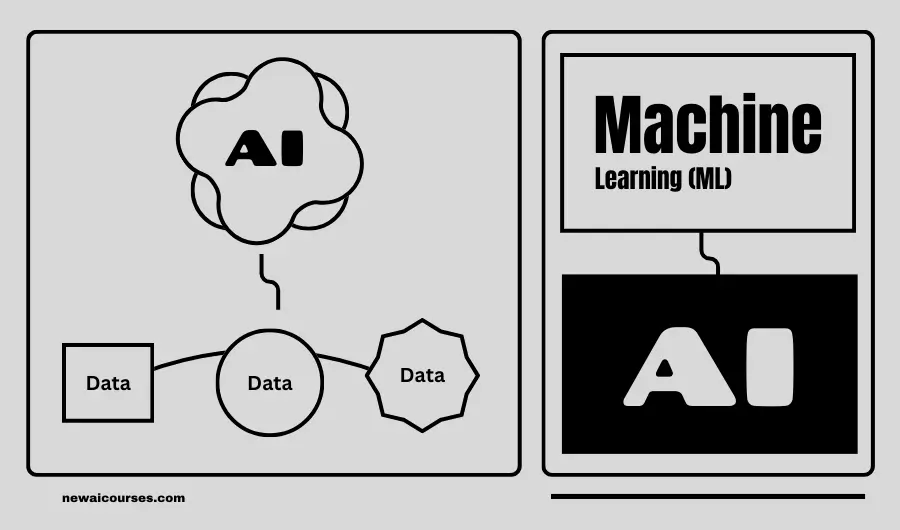
Foundations of Learning From Data
Artificial intelligence learning from data is primarily implemented through the discipline of machine learning, a computational framework in which algorithms improve performance by identifying patterns within structured or unstructured datasets. Rather than relying on explicitly programmed rules, machine learning systems construct mathematical representations of relationships between inputs and outputs. These representations are encoded as parameters within an AI model and are adjusted iteratively during training to minimize prediction error.
The conceptual foundation of this process is grounded in statistical learning theory, which formalizes how algorithms infer generalizable relationships from finite observations. A dataset is treated as a sample drawn from an underlying probability distribution, and the objective of the model is to approximate that distribution closely enough to make accurate predictions on new, unseen data. This principle distinguishes machine learning from deterministic programming because the system’s behavior evolves through exposure to examples rather than static instruction sets.
Modern implementations rely on numerical optimization techniques operating across large parameter spaces. These parameters represent weights that control how strongly different features influence predictions. During training, algorithms repeatedly compare predicted outputs to actual outcomes and adjust the parameters to reduce discrepancies. This iterative adjustment process is what constitutes “learning” in computational terms.
Data Representation and Feature Construction
Before an AI system can learn from data, raw information must be converted into mathematical structures that algorithms can process efficiently. This transformation process is known as data representation. In traditional machine learning systems, engineers manually defined features, which are measurable attributes extracted from raw data. For example, in image recognition tasks, early systems required explicit feature extraction techniques such as edge detection or color histograms.
The evolution of deep learning significantly reduced the need for manual feature engineering by enabling neural networks to automatically discover hierarchical representations. Instead of relying on handcrafted descriptors, layered neural architectures learn increasingly abstract features through successive transformations. Lower layers capture simple patterns such as edges or frequency signals, while deeper layers represent complex structures such as objects, semantic relationships, or contextual dependencies.
Text-based AI systems illustrate this transformation clearly through tokenization and embedding processes. Words or subwords are converted into numerical vectors that encode semantic relationships based on co-occurrence patterns across large corpora. These vector representations allow algorithms to measure similarity between linguistic elements using geometric distance in high-dimensional space. Research initiatives at organizations such as Stanford University have extensively formalized vector-based language representations through foundational work in distributional semantics.
The quality and structure of data representation directly affect model performance. Poorly encoded data can limit a model’s ability to detect meaningful patterns, while well-structured representations enable efficient learning and improved generalization.
Training Paradigms in Machine Learning
AI systems learn through several established training paradigms, each defined by how data is labeled and how feedback is provided. Supervised learning is the most widely deployed framework and involves training models using datasets that include both inputs and corresponding correct outputs. The algorithm learns a mapping function that minimizes prediction error across labeled examples. Applications include image classification, speech recognition, and financial forecasting.
Unsupervised learning operates without labeled outcomes and instead focuses on discovering hidden structure within datasets. Algorithms identify clusters, latent variables, or dimensional relationships that explain how data points relate to one another. Techniques such as principal component analysis and clustering algorithms are commonly used for exploratory pattern discovery and data compression.
Reinforcement learning introduces a feedback-driven paradigm in which an agent learns through interaction with an environment. Instead of receiving labeled examples, the system receives reward signals based on the consequences of its actions. Over time, the agent develops strategies that maximize cumulative reward. This framework has been extensively advanced by research programs at Google DeepMind, particularly in environments requiring sequential decision-making and long-term optimization.
Although these paradigms differ in structure, they share a common mathematical objective: parameter optimization guided by data-driven feedback.
Neural Networks and Deep Learning Architectures
Neural networks form the computational backbone of most modern AI systems. Inspired conceptually by biological neural structures, artificial neural networks consist of interconnected layers of computational units called neurons. Each neuron applies a weighted transformation followed by a nonlinear activation function, enabling the network to model complex relationships that linear systems cannot capture.
Deep learning refers specifically to neural networks containing multiple hidden layers. Increasing depth allows models to represent hierarchical abstractions, making them especially effective for tasks involving images, audio, and natural language. Convolutional neural networks are optimized for spatial data processing, while recurrent and transformer-based architectures are designed for sequential data modeling.
The introduction of transformer architectures fundamentally changed how AI systems learn from large-scale text data. Transformers rely on attention mechanisms that allow models to dynamically focus on different parts of input sequences when generating predictions. This structure enables efficient parallelization during training and improved contextual understanding across long sequences. Research and deployment of transformer-based systems have been extensively developed by organizations such as OpenAI and Microsoft through large-scale language modeling initiatives.
Deep neural networks typically contain millions or billions of parameters, making them capable of approximating highly complex functions when trained on sufficiently large datasets.
Optimization and the Role of Backpropagation
The process through which neural networks adjust their parameters is governed by optimization algorithms, with backpropagation serving as the central computational method. Backpropagation calculates how much each parameter contributes to prediction error by applying the chain rule of calculus across the network’s layers. These gradient values indicate the direction in which parameters should be adjusted to reduce error.
Gradient descent and its variants are then used to iteratively update model weights. During each training iteration, the model processes batches of data, computes prediction errors using a defined loss function, and updates parameters to minimize that loss. Over many iterations, the model converges toward parameter configurations that produce accurate predictions across the training dataset.
Loss functions vary depending on the task. Classification problems often use cross-entropy loss, while regression tasks commonly use mean squared error. The choice of loss function directly influences how learning progresses because it defines the mathematical objective being optimized.
Optimization stability becomes increasingly complex as model size grows. Techniques such as learning rate scheduling, normalization layers, and regularization are used to prevent divergence or overfitting. These strategies ensure that learning remains numerically stable while preserving the model’s ability to generalize beyond the training dataset.
Generalization and Model Evaluation
Learning from data does not end when a model achieves low error on its training set. The central objective of machine learning is generalization, which refers to the model’s ability to perform accurately on previously unseen data. Overfitting occurs when a model memorizes training examples rather than learning underlying patterns, resulting in poor real-world performance.
To evaluate generalization, datasets are typically divided into training, validation, and testing subsets. The training set is used to update parameters, the validation set guides hyperparameter tuning, and the test set measures final performance. This evaluation structure prevents information leakage that could artificially inflate performance metrics.
Statistical metrics are used to quantify predictive accuracy depending on the task domain. Classification systems often rely on precision, recall, and F1 scores, while regression models use error-based metrics such as root mean squared error. These measurements provide objective benchmarks for comparing model performance across architectures or datasets.
Cross-validation techniques further improve reliability by rotating validation splits across multiple training cycles. This approach reduces variance in performance estimates and provides more stable measurements when working with limited data.
Data Scale, Compute Infrastructure, and Model Capacity
The scale of available data significantly influences how effectively AI systems learn. Larger datasets typically allow models to capture more complex relationships and reduce generalization error. However, increasing data scale also requires greater computational resources to process training workloads efficiently.
Modern AI training relies heavily on parallel computing architectures, particularly graphics processing units and specialized tensor accelerators. These hardware platforms enable large matrix operations to be executed efficiently across distributed systems. Cloud-based infrastructure has further accelerated AI development by making large-scale compute accessible to research institutions and enterprises.
Organizations such as IBM and Microsoft have developed enterprise AI platforms that integrate distributed training pipelines with scalable storage systems. These infrastructures support training workflows involving massive datasets and high-parameter models.
Model capacity must be carefully balanced with data scale. If a model contains too few parameters, it may underfit the data and fail to capture meaningful relationships. Conversely, excessively large models trained on limited datasets may overfit. Effective AI learning therefore depends on aligning architecture size, dataset volume, and computational resources.
Real-World Training Pipelines and Iterative Learning Cycles
In production environments, AI systems learn through structured pipelines that extend beyond initial training. These pipelines include data collection, preprocessing, model training, evaluation, deployment, and continuous monitoring. Iterative updates are common because real-world data distributions evolve over time, a phenomenon known as data drift.
Continuous learning strategies address this challenge by periodically retraining models using updated datasets. Monitoring systems track performance metrics to detect when accuracy declines due to changing patterns. Once performance degradation is detected, retraining cycles are triggered to restore predictive reliability.
Large-scale AI deployments often incorporate automated workflow orchestration tools that manage these iterative cycles. For example, enterprise cloud platforms developed by Microsoft integrate automated training pipelines with deployment monitoring to support production-grade machine learning systems.
Research organizations such as OpenAI also employ staged training approaches in which models are first pretrained on large general datasets and later refined using specialized or human-labeled data. This multi-stage learning process allows models to acquire broad knowledge before adapting to domain-specific requirements.
The Relationship Between Data Quality and Learning Outcomes
While data quantity plays a major role in AI performance, data quality is equally critical. Errors, inconsistencies, or biases within training datasets directly affect model behavior because machine learning systems learn statistical patterns exactly as they appear in the data.
Noise in datasets can reduce signal clarity, making it harder for models to converge toward stable parameter configurations. Label inaccuracies in supervised learning tasks can cause systematic prediction errors. Similarly, dataset imbalance may lead models to disproportionately favor dominant classes while underperforming on underrepresented categories.
Data preprocessing techniques address these challenges through normalization, deduplication, and validation workflows. Careful dataset curation improves training efficiency and enhances generalization reliability. This principle has been reinforced through academic research and industrial deployments across large-scale machine learning systems.
Conceptual Limits and Ongoing Research Directions
Although AI systems can learn highly complex patterns from data, their learning remains fundamentally statistical rather than conceptual. Models do not possess intrinsic understanding; instead, they approximate relationships between variables based on probability distributions derived from training examples.
Current research focuses on improving robustness, interpretability, and efficiency in data-driven learning systems. Interpretability methods aim to explain how models arrive at predictions by analyzing parameter contributions or activation patterns. Efficiency research targets reducing computational requirements while preserving performance, particularly for deployment in resource-constrained environments.
Advancements in reinforcement learning, self-supervised learning, and multimodal architectures continue to expand how AI systems learn from increasingly diverse data sources. These developments suggest that the core principle of statistical learning will remain central, while architectures and training methodologies continue to evolve.
Conclusion
AI learns from data through mathematical optimization processes that transform examples into predictive parameter structures. By combining statistical modeling, scalable computation, and structured training paradigms, modern AI systems convert raw information into operational intelligence across real-world applications.
AI Informed Newsletter
Stay informed on the fastest growing technology.
Disclaimer: The content on this page and all pages are for informational purposes only. We use AI to develop and improve our content — we love to use the tools we promote.
Course creators can promote their courses with us and AI apps Founders can get featured mentions on our website, send us an email.
Simplify AI use for the masses, enable anyone to leverage artificial intelligence for problem solving, building products and services that improves lives, creates wealth and advances economies.
A small group of researchers, educators and builders across AI, finance, media, digital assets and general technology.
If we have a shot at making life better, we owe it to ourselves to take it. Artificial intelligence (AI) brings us closer to abundance in health and wealth and we're committed to playing a role in bringing the use of this technology to the masses.
We aim to promote the use of AI as much as we can. In addition to courses, we will publish free prompts, guides and news, with the help of AI in research and content optimization.
We use cookies and other software to monitor and understand our web traffic to provide relevant contents, protection and promotions. To learn how our ad partners use your data, send us an email.
© newvon | all rights reserved | sitemap