

What Is Knowledge-Based AI?
Knowledge-based AI is a form of artificial intelligence that represents human knowledge explicitly and applies logical reasoning over that knowledge to solve problems or make decisions.
Defining Knowledge-Based Artificial Intelligence
Knowledge-based AI refers to artificial intelligence systems that rely on structured representations of human knowledge and formal reasoning mechanisms rather than purely statistical learning. In this approach, information about a domain is encoded in a knowledge base containing facts, rules, and relationships, while a reasoning component—commonly called an inference engine—applies logical procedures to derive conclusions from that stored knowledge.
The concept emerged from early artificial intelligence research in the 1960s and 1970s, when computer scientists sought to replicate expert decision-making through symbolic reasoning. These systems model knowledge explicitly using symbolic structures such as rules, semantic networks, frames, or ontologies. Unlike many modern machine learning systems that infer patterns from data, knowledge-based AI systems depend on carefully constructed knowledge representations that can be interpreted and manipulated through formal logic.
This paradigm is often associated with symbolic AI, which focuses on representing intelligence through symbols and rules. Knowledge-based systems therefore operate through explicit reasoning processes that can often be inspected, explained, and modified by human developers.
Core Architecture of Knowledge-Based Systems
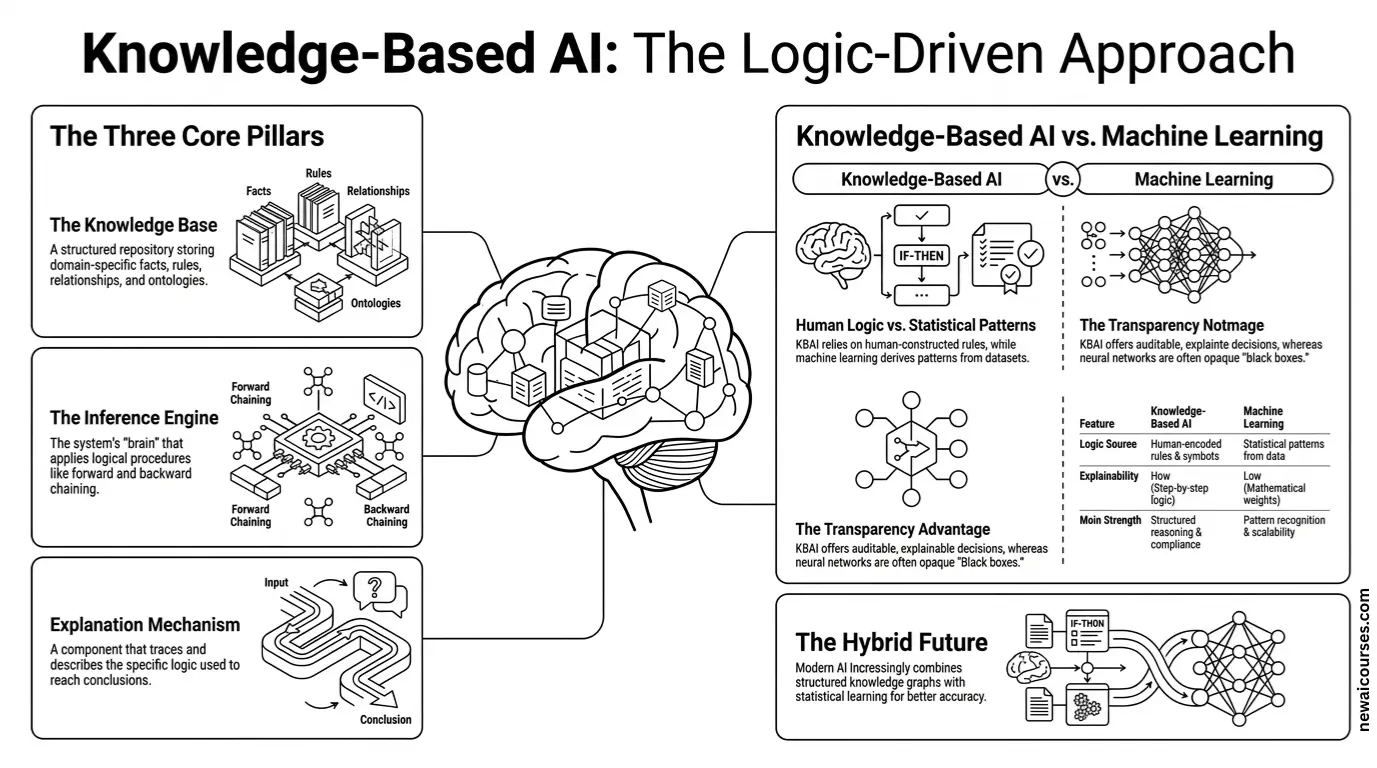
A knowledge-based AI system typically consists of three central components: a knowledge base, an inference engine, and an interface or explanation mechanism that allows interaction with users.
The knowledge base stores domain-specific information in structured form. This information may include facts about entities, relationships among objects, and rules that describe how different pieces of information interact. Knowledge representation techniques vary depending on the application, but common approaches include rule-based logic systems, semantic networks, frames, and ontologies.
The inference engine functions as the reasoning mechanism of the system. It processes the knowledge base by applying logical operations that allow the system to infer new facts or determine appropriate actions. Two widely used reasoning strategies are forward chaining and backward chaining. Forward chaining begins with known facts and applies rules to derive new conclusions, while backward chaining starts with a goal or hypothesis and works backward through the rules to determine whether the hypothesis can be supported.
Many knowledge-based systems also include an explanation component that can describe how a particular conclusion was reached. Because reasoning occurs through explicit logical rules rather than opaque statistical models, the decision-making process can often be traced step by step.
Knowledge Representation in Artificial Intelligence
The effectiveness of a knowledge-based AI system depends heavily on how knowledge is represented. Knowledge representation is a major research area within artificial intelligence because the structure of information directly influences the system’s ability to reason accurately.
One of the most widely used approaches is rule-based representation, in which knowledge is expressed as conditional statements following an “if-then” format. In this structure, a rule might state that if specific conditions are true, a particular conclusion or action should follow. Rule-based systems became widely used in early expert systems because they resemble human reasoning patterns in many decision-making contexts.
Semantic networks represent knowledge as interconnected nodes and relationships, forming a graph structure that models associations among concepts. Frames provide another representation technique by organizing knowledge into structured data objects that describe attributes and relationships of entities. Ontologies, widely used in modern knowledge engineering, define formal vocabularies and relationships within a domain, enabling systems to share and interpret knowledge consistently across applications.
Research in knowledge representation has been strongly influenced by work in logic and cognitive science. Formal logic frameworks, particularly first-order predicate logic, have played a central role in enabling machines to perform structured reasoning over symbolic representations.
Expert Systems and the Early Development of Knowledge-Based AI
Knowledge-based AI gained significant prominence during the development of expert systems in the 1970s and 1980s. Expert systems were designed to replicate the decision-making capabilities of human specialists by encoding their expertise into computer systems.
One of the most influential early systems was MYCIN, developed at Stanford University in the early 1970s by researchers including Edward Shortliffe. MYCIN was designed to assist physicians in diagnosing bacterial infections and recommending antibiotic treatments. The system used a large set of medical rules derived from expert knowledge and applied probabilistic reasoning techniques to generate recommendations.
Another well-known example is DENDRAL, created at Stanford University to assist chemists in identifying molecular structures based on mass spectrometry data. DENDRAL demonstrated how domain expertise encoded in rule-based form could significantly improve problem-solving performance in specialized scientific fields.
These early systems illustrated both the strengths and limitations of knowledge-based AI. They showed that explicit expert knowledge could be captured and applied systematically, but they also revealed the challenges of acquiring and maintaining large bodies of domain knowledge.
Knowledge Engineering and System Development
The process of building knowledge-based AI systems is known as knowledge engineering. This discipline focuses on extracting expertise from human specialists and translating it into structured representations that a computer system can interpret.
Knowledge engineering involves identifying relevant concepts within a domain, defining relationships among those concepts, and formalizing decision rules that guide reasoning. Because domain experts often possess tacit knowledge that is difficult to articulate explicitly, the knowledge acquisition phase can be one of the most complex aspects of system development.
To support knowledge engineering, specialized tools and frameworks were developed during the expansion of expert systems. These tools allowed developers to construct rule bases and reasoning engines without building an entire system from scratch. The goal was to separate domain knowledge from the reasoning mechanisms so that knowledge could be updated independently as expertise evolved.
Modern Applications of Knowledge-Based AI
Although machine learning and data-driven AI now dominate many areas of artificial intelligence, knowledge-based approaches continue to play a crucial role in domains that require structured reasoning and explainability.
One major modern application involves semantic technologies and knowledge graphs. Large technology companies including Google and Microsoft use knowledge graph architectures to represent relationships among entities such as people, locations, organizations, and concepts. These systems allow search engines and digital assistants to interpret queries in a structured semantic context rather than relying solely on keyword matching.
In healthcare and biomedical research, structured knowledge bases are used to represent complex relationships among diseases, treatments, and biological processes. The Unified Medical Language System, developed by the U.S. National Library of Medicine, provides an example of a large biomedical knowledge structure designed to support information retrieval and clinical research.
Knowledge-based reasoning also remains important in industrial applications such as configuration systems, diagnostic tools, and regulatory compliance systems, where decisions must be transparent and traceable.
Knowledge-Based AI Compared With Machine Learning
Knowledge-based-AI infographic
Knowledge-based AI differs fundamentally from modern machine learning approaches in how systems acquire and apply knowledge. Machine learning systems, particularly those based on neural networks, derive patterns directly from large datasets through statistical optimization. These systems typically do not contain explicit symbolic representations of knowledge that can be inspected or modified by developers.
In contrast, knowledge-based AI relies on human-constructed representations of expertise. Rules, ontologies, and symbolic structures are explicitly defined, allowing reasoning processes to be transparent and explainable. This characteristic makes knowledge-based systems particularly valuable in environments where decisions must be auditable or where regulatory oversight requires clear justification.
However, the reliance on manual knowledge engineering can also limit scalability. Constructing comprehensive knowledge bases requires significant domain expertise and ongoing maintenance as information evolves. Machine learning systems often handle large volumes of unstructured data more efficiently because they automatically learn patterns without requiring explicit rule creation.
Hybrid Approaches and the Future of Knowledge-Based AI
Recent developments in artificial intelligence increasingly combine knowledge-based reasoning with machine learning techniques. Hybrid architectures integrate structured knowledge bases with statistical learning models to improve reasoning accuracy and contextual understanding.
For example, knowledge graphs can provide structured contextual information that enhances the performance of machine learning models used in natural language processing. Research organizations such as OpenAI and DeepMind have explored methods that incorporate structured knowledge representations into advanced AI systems to improve reasoning capabilities and reduce errors in complex tasks.
This integration reflects a broader recognition within artificial intelligence research that symbolic reasoning and data-driven learning offer complementary strengths. Knowledge-based AI provides explicit structure and interpretability, while machine learning contributes powerful pattern recognition capabilities.
As artificial intelligence continues to expand into domains requiring both reliability and transparency, knowledge-based techniques remain an essential component of the broader AI ecosystem. Their emphasis on structured reasoning, explainability, and domain expertise ensures that knowledge-based systems continue to play a significant role in the design of advanced intelligent technologies.
AI Informed Newsletter
Stay informed on the fastest growing technology.
Disclaimer: The content on this page and all pages are for informational purposes only. We use AI to develop and improve our content — we love to use the tools we promote.
Course creators can promote their courses with us and AI apps Founders can get featured mentions on our website, send us an email.
Simplify AI use for the masses, enable anyone to leverage artificial intelligence for problem solving, building products and services that improves lives, creates wealth and advances economies.
A small group of researchers, educators and builders across AI, finance, media, digital assets and general technology.
If we have a shot at making life better, we owe it to ourselves to take it. Artificial intelligence (AI) brings us closer to abundance in health and wealth and we're committed to playing a role in bringing the use of this technology to the masses.
We aim to promote the use of AI as much as we can. In addition to courses, we will publish free prompts, guides and news, with the help of AI in research and content optimization.
We use cookies and other software to monitor and understand our web traffic to provide relevant contents, protection and promotions. To learn how our ad partners use your data, send us an email.
© newvon | all rights reserved | sitemap