

What is Machine Reasoning?
Machine reasoning is a field of artificial intelligence that enables computers to derive conclusions from data using formal logic, structured knowledge, and inference mechanisms.
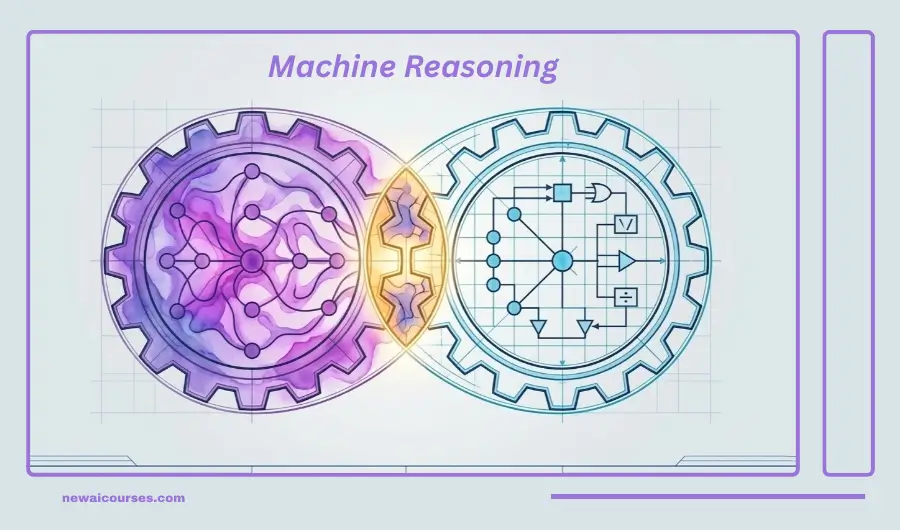
Foundations of Machine Reasoning
Machine reasoning refers to the computational process through which an artificial intelligence system derives logical conclusions from a set of known facts, rules, or representations. Unlike statistical prediction systems that rely primarily on pattern recognition, reasoning systems apply structured logic to determine outcomes that follow from explicitly defined premises. The core objective is to enable machines to perform forms of problem solving, decision making, and knowledge derivation that resemble aspects of human logical reasoning.
The discipline emerged from early work in artificial intelligence during the mid-twentieth century, when researchers attempted to encode human knowledge into symbolic representations that computers could manipulate. Early research conducted at institutions such as the Massachusetts Institute of Technology and Stanford University focused on symbolic logic, theorem proving, and rule-based inference. These systems operated on structured knowledge bases composed of formal statements, allowing computers to evaluate logical relationships and deduce new information.
Machine reasoning remains closely tied to symbolic artificial intelligence, where knowledge is represented through logic statements, semantic networks, ontologies, or rule sets. These representations provide a structured environment in which computational inference mechanisms can systematically derive conclusions from existing information.
Logical Inference and Reasoning Mechanisms
At the center of machine reasoning are inference mechanisms that operate on formal representations of knowledge. An inference engine applies logical operations to determine whether a particular conclusion follows from a known set of rules and facts. This computational reasoning process typically relies on formal logic systems derived from mathematical logic.
Deductive reasoning is the most traditional form used in machine reasoning systems. In deductive frameworks, conclusions are guaranteed to be true if the underlying premises are true and the logical rules are valid. Systems designed for theorem proving or formal verification often rely on deductive reasoning to determine whether a statement logically follows from a given knowledge base.
Another form of reasoning used in artificial intelligence is abductive reasoning, which focuses on identifying the most plausible explanation for observed evidence. Abductive reasoning is frequently used in diagnostic systems where the system must infer possible causes of a problem based on observable symptoms. Similarly, inductive reasoning allows systems to infer general patterns from specific examples, although inductive reasoning is more commonly associated with machine learning than with classical symbolic reasoning.
These reasoning mechanisms operate through structured inference engines that evaluate logical relationships step by step. The process often involves pattern matching, rule activation, and the iterative derivation of new facts until a conclusion or solution is reached.
Knowledge Representation in Reasoning Systems
Machine reasoning depends heavily on how knowledge is represented within a computational system. Knowledge representation refers to the formal structures used to encode information so that it can be processed by reasoning algorithms. Without structured representation, logical inference becomes computationally infeasible.
One widely used approach involves rule-based systems in which knowledge is encoded as conditional statements. These rules typically follow an "if–then" structure that specifies the logical consequences of particular conditions. When a reasoning engine encounters facts that satisfy the conditions of a rule, it can derive the corresponding conclusion.
Another representation method involves formal logic languages such as first-order logic. In these systems, knowledge is expressed as logical predicates and relations between entities. This allows reasoning systems to perform sophisticated logical deductions by evaluating relationships between objects, properties, and conditions.
Ontologies represent another important form of structured knowledge used in machine reasoning. Ontologies define categories of entities and the relationships between them, allowing reasoning systems to infer implicit knowledge based on hierarchical or semantic relationships. The development of the World Wide Web Consortium Semantic Web standards, including the Web Ontology Language (OWL), introduced formal frameworks that enable reasoning engines to derive knowledge from structured web data.
Inference Engines and Reasoning Architectures
The practical implementation of machine reasoning relies on computational components known as inference engines. These engines evaluate knowledge bases using formal reasoning algorithms that determine which rules apply and what conclusions can be logically derived.
One classical approach involves forward chaining, where the reasoning engine begins with known facts and repeatedly applies rules to derive new information. This process continues until no additional conclusions can be generated or until a specific goal condition is satisfied.
Another approach involves backward chaining, which starts with a desired conclusion and works backward through the rule base to determine whether supporting facts exist. Backward chaining is particularly useful in systems designed for diagnostic reasoning or question answering because it focuses computation on verifying specific hypotheses rather than exploring all possible inferences.
The reasoning engine used in the MYCIN expert system, developed at Stanford University in the 1970s, employed rule-based reasoning to assist physicians in identifying bacterial infections and recommending antibiotic treatments. MYCIN demonstrated how structured knowledge combined with logical inference could support complex decision-making tasks in specialized domains.
Machine Reasoning in Modern Artificial Intelligence
While early artificial intelligence research focused heavily on symbolic reasoning systems, modern AI often integrates reasoning techniques with machine learning. Machine learning excels at identifying statistical patterns within large datasets, but it does not inherently perform explicit logical inference. Machine reasoning provides complementary capabilities that enable systems to manipulate structured knowledge, enforce logical constraints, and generate explainable conclusions.
Organizations such as IBM have explored hybrid approaches that combine reasoning with data-driven learning. The system IBM Watson incorporates reasoning mechanisms alongside large-scale information retrieval and machine learning techniques to answer complex natural language questions.
Research institutions including DeepMind have also investigated integrating neural networks with symbolic reasoning systems. These efforts aim to combine the pattern recognition capabilities of deep learning with the logical structure of symbolic reasoning, enabling AI systems to solve problems that require both perception and formal reasoning.
Applications of Machine Reasoning
Machine reasoning plays a critical role in applications where logical correctness, traceability, and structured decision making are essential. One of the most prominent applications appears in automated theorem proving systems, where computers evaluate mathematical statements to determine whether they follow from a set of axioms. Projects such as the theorem prover developed by Microsoft Research demonstrate how reasoning systems can verify complex logical relationships in formal mathematics and computer science.
Another important application involves formal verification of software and hardware systems. Formal verification tools use machine reasoning techniques to mathematically prove whether a system design satisfies specified correctness properties. These methods are widely used in safety-critical domains such as aerospace, cryptographic systems, and processor design.
Knowledge-based decision support systems also rely heavily on machine reasoning. These systems analyze structured domain knowledge to assist professionals in areas such as medicine, engineering, and legal analysis. By tracing the logical path that leads to a recommendation, reasoning systems can provide explanations that help users understand and validate the system’s conclusions.
Distinction Between Machine Reasoning and Machine Learning
Machine reasoning is often discussed alongside machine learning, but the two fields operate according to fundamentally different principles. Machine learning systems learn statistical relationships from data through optimization algorithms and training processes. These systems excel at tasks such as image recognition, speech processing, and predictive modeling.
Machine reasoning, in contrast, focuses on manipulating explicitly represented knowledge through formal logic and inference rules. Rather than learning patterns directly from raw data, reasoning systems operate on structured knowledge bases that encode facts, rules, and relationships.
This distinction has significant implications for explainability. Because machine reasoning systems derive conclusions through explicit logical steps, they can often provide a clear explanation of how a particular result was obtained. Machine learning systems, particularly deep neural networks, typically produce predictions without an explicit reasoning trace.
The Continuing Role of Machine Reasoning
Machine reasoning remains an important area of research within artificial intelligence because many complex problems require structured logic in addition to statistical learning. Tasks involving legal interpretation, mathematical proof, scientific reasoning, and complex decision analysis often demand explicit logical inference that cannot be reliably achieved through pattern recognition alone.
Contemporary AI research increasingly explores hybrid architectures that combine machine reasoning with machine learning and large-scale data processing. These systems aim to integrate logical knowledge representation with adaptive learning capabilities, allowing artificial intelligence to both discover patterns and reason about them.
As artificial intelligence systems are deployed in domains that require transparency, safety, and verifiable decision making, machine reasoning continues to provide the logical foundation necessary for building trustworthy computational intelligence.
AI Informed Newsletter
Stay informed on the fastest growing technology.
Disclaimer: The content on this page and all pages are for informational purposes only. We use AI to develop and improve our content — we love to use the tools we promote.
Course creators can promote their courses with us and AI apps Founders can get featured mentions on our website, send us an email.
Simplify AI use for the masses, enable anyone to leverage artificial intelligence for problem solving, building products and services that improves lives, creates wealth and advances economies.
A small group of researchers, educators and builders across AI, finance, media, digital assets and general technology.
If we have a shot at making life better, we owe it to ourselves to take it. Artificial intelligence (AI) brings us closer to abundance in health and wealth and we're committed to playing a role in bringing the use of this technology to the masses.
We aim to promote the use of AI as much as we can. In addition to courses, we will publish free prompts, guides and news, with the help of AI in research and content optimization.
We use cookies and other software to monitor and understand our web traffic to provide relevant contents, protection and promotions. To learn how our ad partners use your data, send us an email.
© newvon | all rights reserved | sitemap