

What Is Model Degradation?
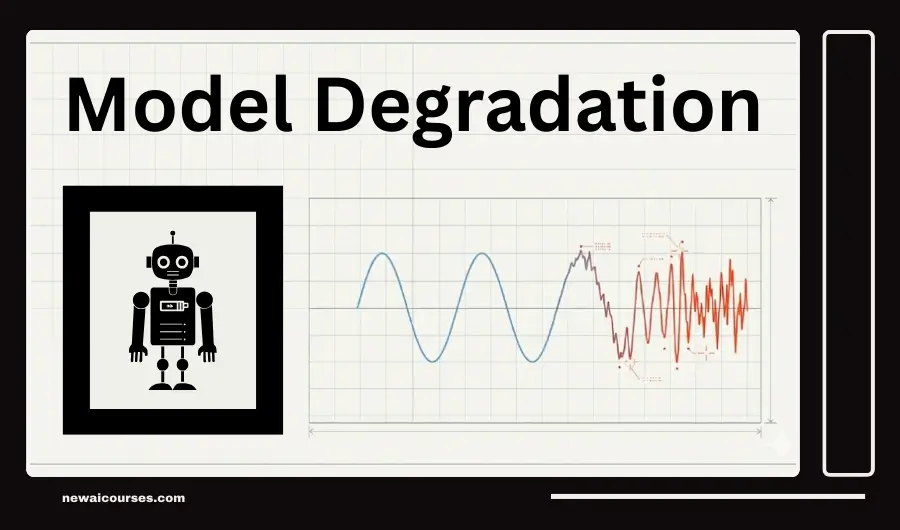
Model degradation is the gradual decline in a machine learning model’s performance as the statistical patterns in real-world data diverge from those present in its training dataset.
Defining Model Degradation in Machine Learning
In machine learning systems, a model is trained on historical data to learn statistical relationships between inputs and outputs. Once deployed, the model operates on new data that ideally follows the same distribution as the training data. Model degradation occurs when this assumption no longer holds and the model’s predictions become less accurate or reliable over time.
Performance decline can manifest in several measurable ways, including reduced prediction accuracy, increased error rates, or instability in model outputs. In production environments, these changes are typically detected through monitoring metrics such as precision, recall, mean squared error, or classification accuracy. When these metrics drift away from established benchmarks, it signals that the model is no longer generalizing effectively to the data it encounters.
Model degradation is a recognized challenge in operational machine learning systems. The phenomenon reflects the reality that many real-world environments are dynamic rather than static, meaning the patterns a model originally learned may gradually lose relevance.
The Role of Data Distribution in Model Performance
Machine learning models depend on the assumption that training and production data follow similar statistical distributions. This principle, often described in statistical learning theory, underpins the ability of models to generalize from historical observations to unseen data.
When the distribution of incoming data changes, the model’s internal representations may no longer align with the underlying patterns of the environment. As a result, predictions become less reliable even though the model itself has not changed.
This shift can occur gradually or abruptly. For example, consumer behavior in an online retail platform may evolve due to seasonal trends, economic conditions, or changes in user interface design. A recommendation model trained on earlier purchasing patterns may begin producing weaker recommendations as those patterns evolve.
Organizations operating large-scale machine learning systems, including platforms developed by companies such as Google, Netflix, and Amazon, design monitoring infrastructure specifically to detect these performance declines in production models.
Concept Drift and Data Drift
Two technical mechanisms are widely recognized as primary drivers of model degradation: concept drift and data drift.
Concept drift occurs when the relationship between input variables and the target outcome changes. In other words, the meaning of the prediction itself evolves. For example, an email classification model trained to detect spam may perform well initially, but as spammers adopt new wording strategies, the relationship between message features and the label “spam” changes.
Data drift, by contrast, refers to shifts in the statistical distribution of input data without necessarily altering the relationship between inputs and outputs. A computer vision model trained to detect objects in daylight images may experience data drift if the deployment environment begins producing images with different lighting conditions or camera characteristics.
Both phenomena cause models to encounter data patterns they were not originally optimized to handle. Over time, this mismatch reduces predictive accuracy and reliability.
Model Aging and Environmental Change
Model degradation is often described as a form of model aging. The concept reflects the idea that models, like other engineered systems, gradually lose effectiveness as the environment they operate in evolves.
Real-world environments frequently change due to economic shifts, policy updates, user behavior trends, or technological modifications. For instance, a credit risk model trained on historical lending data may become less accurate if regulatory frameworks change or if borrower demographics shift significantly.
Financial institutions using machine learning systems for credit scoring and fraud detection, including firms operating under regulatory oversight such as those monitored by the U.S. Securities and Exchange Commission or similar regulators, must regularly evaluate models to ensure they remain valid under changing conditions.
This need for continuous oversight is a fundamental principle of modern machine learning operations, often referred to as MLOps.
Measuring Model Degradation
Detecting model degradation requires systematic monitoring of performance metrics in production environments. These metrics depend on the type of machine learning task being performed.
For classification models, monitoring typically involves metrics such as accuracy, precision, recall, and the F1 score. For regression models, organizations often track measures such as mean absolute error or root mean squared error. A consistent increase in error or decline in accuracy signals that the model’s predictive ability is deteriorating.
Monitoring systems also track data-level indicators such as distribution changes in input features. If certain variables begin appearing in ranges that were rare or absent during training, this may indicate data drift that could affect predictions.
Large-scale production platforms—including machine learning infrastructure tools developed by Microsoft through its Azure Machine Learning platform and by Google through Vertex AI—provide built-in monitoring features designed to detect both performance degradation and data distribution changes.
Retraining and Model Maintenance
Addressing model degradation typically requires updating or retraining the model with more recent data. Retraining allows the system to learn from new patterns that were not present in the original dataset.
In many production systems, retraining occurs on a scheduled basis. For example, recommendation engines or advertising models may be retrained daily or weekly to incorporate the latest user interaction data. In other contexts, retraining may occur only when monitoring systems detect significant performance decline.
Some organizations implement automated retraining pipelines that continuously ingest fresh data and update models without manual intervention. These pipelines form a central component of modern machine learning lifecycle management.
However, retraining must be carefully managed to prevent introducing new errors or biases. Updated models typically undergo validation testing to ensure they outperform or at least match the existing model before deployment.
Model Degradation in Real-World Systems
Many widely deployed machine learning systems must account for model degradation because their operating environments evolve rapidly. Online recommendation engines, fraud detection systems, and advertising algorithms are particularly sensitive to changes in user behavior.
For example, recommendation models used by streaming platforms such as Netflix depend on evolving viewing patterns. As new content is released and audience preferences shift, historical data becomes less representative of current behavior. Without regular retraining, the model’s recommendations would gradually become less relevant.
Similarly, search ranking algorithms maintained by Google must adapt to changes in web content, user queries, and search behavior. Continuous model updates are therefore necessary to maintain search relevance.
These examples illustrate why long-term machine learning deployments require ongoing maintenance rather than one-time model development.
Distinguishing Model Degradation from Model Failure
Model degradation should not be confused with catastrophic model failure. Degradation typically occurs gradually as performance metrics slowly decline over time. The model continues to function but becomes progressively less accurate.
Model failure, by contrast, involves sudden breakdowns in system behavior. This may occur if the model encounters input data that falls completely outside the range of its training distribution or if upstream data pipelines malfunction.
Understanding this distinction is important for operational monitoring. Gradual degradation can often be mitigated through retraining or recalibration, whereas sudden failures may require immediate investigation of system infrastructure or data integrity.
The Importance of Lifecycle Management in Machine Learning
The concept of model degradation highlights a broader principle in machine learning engineering: models are not static assets but dynamic components that must be maintained throughout their operational lifecycle.
Modern machine learning practice therefore emphasizes continuous monitoring, validation, and retraining. This lifecycle approach ensures that models remain aligned with evolving data environments and maintain reliable predictive performance.
As machine learning systems become embedded in critical applications, from digital platforms to financial services, the ability to detect and address model degradation has become a central discipline within machine learning operations. Continuous evaluation ensures that predictive systems remain both technically effective and operationally trustworthy over time.
AI Informed Newsletter
Stay informed on the fastest growing technology.
Disclaimer: The content on this page and all pages are for informational purposes only. We use AI to develop and improve our content — we love to use the tools we promote.
Course creators can promote their courses with us and AI apps Founders can get featured mentions on our website, send us an email.
Simplify AI use for the masses, enable anyone to leverage artificial intelligence for problem solving, building products and services that improves lives, creates wealth and advances economies.
A small group of researchers, educators and builders across AI, finance, media, digital assets and general technology.
If we have a shot at making life better, we owe it to ourselves to take it. Artificial intelligence (AI) brings us closer to abundance in health and wealth and we're committed to playing a role in bringing the use of this technology to the masses.
We aim to promote the use of AI as much as we can. In addition to courses, we will publish free prompts, guides and news, with the help of AI in research and content optimization.
We use cookies and other software to monitor and understand our web traffic to provide relevant contents, protection and promotions. To learn how our ad partners use your data, send us an email.
© newvon | all rights reserved | sitemap