

What Is Model Drift?
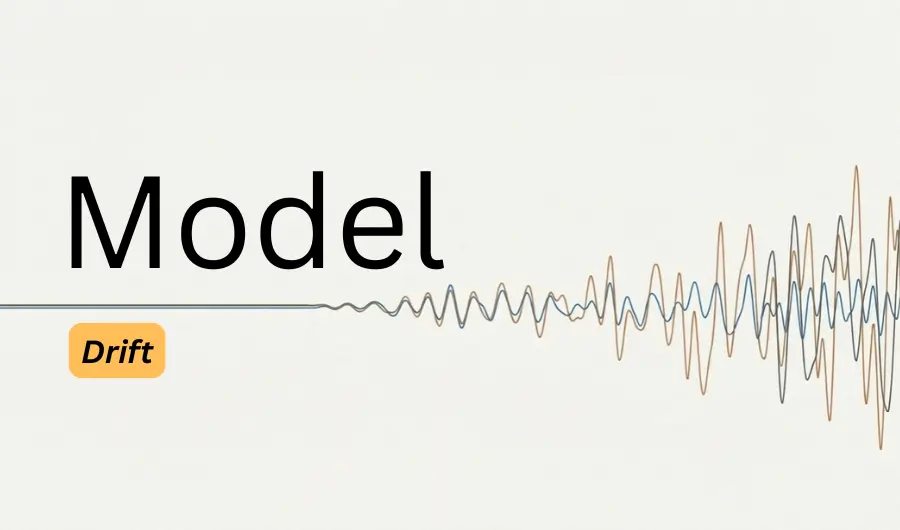
Model drift occurs when a deployed machine learning model’s predictive performance degrades over time because the statistical properties of real-world data change.
Understanding the Concept of Model Drift
Model drift describes the gradual or sudden decline in the accuracy or reliability of a machine learning model after it has been deployed in production. While a model may perform well during development and testing, the environment in which it operates can evolve, causing the assumptions embedded in the trained model to become misaligned with real-world conditions.
Machine learning models are trained using historical datasets that capture patterns present at a particular time. When those patterns change, the relationships the model learned may no longer represent reality. As a result, predictions begin to deviate from correct outcomes, even though the model architecture and parameters remain unchanged. This phenomenon is broadly referred to as model drift and is widely recognized within the discipline of machine learning operations.
Why Model Drift Occurs
Model drift occurs because the world that produces data is dynamic. Changes in user behavior, economic conditions, regulatory frameworks, technological systems, or natural processes can alter the statistical distribution of incoming data. A model trained on older data cannot automatically adapt to these evolving conditions unless it is retrained or updated.
In production environments, machine learning models interact continuously with live data streams. If these streams gradually diverge from the data distribution used during training, prediction errors begin to accumulate. For example, a fraud detection model trained on historical financial transactions may lose accuracy if new fraud techniques emerge that differ from past patterns. The underlying model has not failed structurally; instead, the environment has shifted beyond the scope of its learned representation.
The concept of distributional shift underlying model drift is well established in machine learning literature. The textbook Pattern Recognition and Machine Learning by Christopher M. Bishop discusses how predictive models rely on the assumption that training and operational data share similar statistical distributions. When that assumption breaks down, model performance deteriorates.
Distinguishing Model Drift from Data Drift
Although model drift is often discussed alongside data drift, the two concepts are technically distinct. Data drift refers specifically to changes in the statistical properties of input variables. Model drift, in contrast, refers to the observable decline in the model’s predictive accuracy or reliability.
A change in data distribution does not automatically produce model drift. Some models remain robust despite moderate shifts in input data. However, when those shifts alter the relationships between inputs and outcomes in ways the model cannot accommodate, the degradation in predictive performance becomes measurable.
Machine learning practitioners therefore monitor both phenomena separately. Data drift detection focuses on identifying changes in feature distributions, while model drift monitoring focuses on tracking prediction quality using metrics such as accuracy, precision, recall, or error rate.
Real-World Examples of Model Drift
Model drift frequently appears in large-scale machine learning systems deployed in industry. Organizations operating high-volume data platforms have publicly documented the need to manage drift in production models.
Google addressed the issue in its paper “Hidden Technical Debt in Machine Learning Systems,” published by engineers including D. Sculley. The paper explains how production models accumulate technical debt when data distributions evolve and models are not continuously maintained. Over time, prediction quality deteriorates unless monitoring and retraining processes are implemented.
Similarly, Netflix maintains recommendation algorithms that must adapt to rapidly changing viewing behavior. If user preferences shift due to new genres, regional trends, or cultural events, models trained on older behavioral patterns may produce less relevant recommendations. Continuous retraining and performance evaluation are therefore integrated into Netflix’s machine learning infrastructure.
Financial institutions also encounter model drift in credit risk models. If economic conditions change, historical lending data may no longer represent the risk profiles of new borrowers. Institutions using machine learning for risk scoring must periodically recalibrate models to ensure predictions remain aligned with current economic realities.
Types of Model Drift
Model drift can emerge through several mechanisms, each reflecting a different way in which the operational environment diverges from training conditions.
One common mechanism occurs when the relationship between input variables and target outcomes changes. In this situation, the predictive mapping learned by the model becomes outdated because the underlying process generating outcomes has evolved. For example, a demand forecasting model may lose accuracy if consumer purchasing patterns change due to economic disruptions.
Another mechanism arises when feedback loops alter the system generating data. Recommendation systems are particularly susceptible to this effect. When a model influences user behavior through its recommendations, the resulting interactions reshape the dataset used for future predictions. Over time, the model may reinforce patterns that distort the original data distribution.
External structural changes can also trigger model drift. Regulatory policy shifts, software updates, demographic transitions, and new market entrants can alter system dynamics in ways not represented in the training dataset.
Detecting Model Drift
Detecting model drift requires systematic monitoring of model performance after deployment. In production machine learning systems, prediction quality is tracked using metrics aligned with the model’s task.
For classification models, metrics such as accuracy, precision, recall, and F1 score provide indicators of performance degradation. For regression models, practitioners commonly monitor error measurements such as mean squared error or mean absolute error.
When these metrics deviate significantly from baseline performance measured during validation, model drift may be occurring. Production monitoring systems therefore compare current prediction results with historical performance benchmarks.
Modern machine learning infrastructure often integrates automated monitoring pipelines. Amazon Web Services provides drift monitoring tools within Amazon SageMaker, allowing practitioners to track prediction quality and detect changes in data distributions. Similarly, Google includes monitoring capabilities within Vertex AI to identify shifts that could degrade deployed models.
These systems enable continuous evaluation of model performance in live environments, making it possible to detect drift before prediction errors significantly affect downstream applications.
Mitigating and Managing Model Drift
Managing model drift requires operational practices that treat machine learning models as evolving systems rather than static artifacts. Once deployed, models must be continuously monitored, evaluated, and periodically retrained using updated datasets.
Retraining allows models to incorporate newly observed patterns and restore alignment between predictions and current conditions. The frequency of retraining depends on the volatility of the environment in which the model operates. High-velocity domains such as financial markets, online advertising, and recommendation systems often require frequent model updates.
In addition to retraining, practitioners sometimes redesign model architectures to improve robustness to distribution shifts. Techniques such as regularization, domain adaptation, and ensemble modeling can reduce sensitivity to environmental change.
Machine learning operations frameworks formalize these processes. Within the discipline of MLOps, model monitoring, retraining pipelines, and automated evaluation workflows ensure that deployed models maintain acceptable levels of performance over time.
The Role of Model Drift in Modern Machine Learning Systems
Model drift has become a central concern in large-scale machine learning deployment because modern AI systems increasingly operate in continuously changing environments. Unlike traditional software programs whose behavior remains fixed, machine learning models depend on statistical patterns that may evolve unpredictably.
Recognizing and managing model drift is therefore essential for maintaining reliability in AI-driven systems. Organizations deploying machine learning at scale must treat model performance as a dynamic property that requires ongoing observation and adjustment.
As machine learning applications expand across domains such as healthcare, finance, logistics, and digital services, the ability to detect and respond to model drift has become a fundamental component of responsible and effective AI system design.
AI Informed Newsletter
Stay informed on the fastest growing technology.
Disclaimer: The content on this page and all pages are for informational purposes only. We use AI to develop and improve our content — we love to use the tools we promote.
Course creators can promote their courses with us and AI apps Founders can get featured mentions on our website, send us an email.
Simplify AI use for the masses, enable anyone to leverage artificial intelligence for problem solving, building products and services that improves lives, creates wealth and advances economies.
A small group of researchers, educators and builders across AI, finance, media, digital assets and general technology.
If we have a shot at making life better, we owe it to ourselves to take it. Artificial intelligence (AI) brings us closer to abundance in health and wealth and we're committed to playing a role in bringing the use of this technology to the masses.
We aim to promote the use of AI as much as we can. In addition to courses, we will publish free prompts, guides and news, with the help of AI in research and content optimization.
We use cookies and other software to monitor and understand our web traffic to provide relevant contents, protection and promotions. To learn how our ad partners use your data, send us an email.
© newvon | all rights reserved | sitemap