

What Is Multimodal AI?
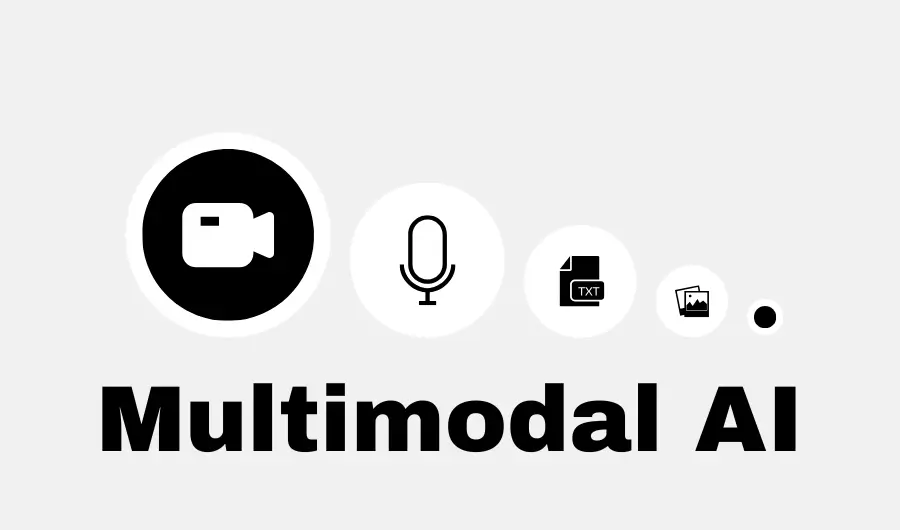
Multimodal AI is one of the most important developments in artificial intelligence today because it fundamentally changes how machines understand the world.
Instead of processing a single type of data in isolation such as only text or only images, multimodal AI systems are designed to understand, interpret, and reason across multiple forms of information at the same time. These forms, known as modalities, can include text, images, audio, video, numerical data, sensor signals, and even structured databases. By combining these modalities, multimodal AI moves closer to how humans naturally perceive and make sense of reality, where meaning is rarely confined to just one channel.
At a high level, multimodal AI aims to create systems that can see, hear, read, and reason together. This integration allows AI to generate richer insights, more accurate predictions, and more natural interactions. As digital environments become more complex and data becomes more diverse, the ability to operate across modalities is increasingly critical. Multimodal AI is not just an incremental improvement over earlier models; it represents a shift toward more general, flexible, and context-aware intelligence.
Understanding Modalities in Artificial Intelligence
To understand multimodal AI, it is essential to first understand what a modality is. In AI, a modality refers to a specific type or channel of information. Text is one modality, images are another, audio is another, and so on. Traditional AI systems were largely unimodal, meaning they were trained and optimized to work with a single modality at a time. For example, natural language processing models focused solely on text, computer vision systems focused on images or video, and speech recognition models focused on audio.
Each unimodal system required its own architecture, training data, and optimization techniques. While these systems achieved impressive results in their specific domains, they were limited in their ability to understand broader context. A text-only model cannot see what an image depicts, and an image-only model cannot understand the nuance conveyed by language. This separation made it difficult to build AI systems that could operate effectively in real-world scenarios, where information is almost always multimodal.
Multimodal AI breaks down these silos by allowing multiple modalities to be processed and combined within a single system. Instead of treating text, images, and audio as unrelated inputs, a multimodal model learns shared representations that connect meaning across these different data types.
How Multimodal AI Works
At its core, multimodal AI relies on the idea that different modalities can reinforce and complement one another. A multimodal system typically consists of three key stages: modality-specific encoding, cross-modal alignment, and joint reasoning or generation.
In the encoding stage, raw inputs from each modality are transformed into numerical representations that the model can work with. For example, text may be converted into embeddings using a language encoder, images may be processed through a vision encoder, and audio may be transformed into spectrogram-based representations. Each encoder is specialized for its modality, capturing relevant patterns and features.
The alignment stage is where multimodal AI truly distinguishes itself. During this phase, the model learns how information from different modalities relates to one another. For instance, it learns that the word “dog” often corresponds to certain visual features in images, or that a particular sound pattern aligns with spoken words. This alignment can be learned through large-scale training on paired data, such as image-caption datasets, video-with-audio datasets, or multimodal conversations.
Finally, in the reasoning or generation stage, the model uses these aligned representations to perform tasks such as answering questions, generating descriptions, making predictions, or carrying out actions. Because the model has access to multiple modalities at once, it can draw on richer context and produce more accurate and meaningful outputs.
Key Characteristics of Multimodal AI Systems
One defining characteristic of multimodal AI is contextual richness. By combining multiple sources of information, these systems can interpret situations more holistically. For example, understanding a video clip becomes far more accurate when visual frames, spoken dialogue, background sounds, and on-screen text are all analyzed together.
Another key characteristic is robustness. Multimodal systems can often compensate when one modality is incomplete or noisy. If an image is blurry, accompanying text may clarify what is happening. If audio is unclear, visual cues can provide additional information. This redundancy makes multimodal AI more resilient in real-world environments.
Multimodal AI systems are also more flexible and general-purpose. Rather than being limited to a narrow task, they can often adapt to a wide range of use cases without being retrained from scratch. This adaptability is one reason multimodal models are seen as a step toward more general artificial intelligence.
Examples of Multimodal AI in Practice
Many of the most advanced AI systems in use today are already multimodal. Virtual assistants that can understand spoken commands, interpret images from a camera, and respond in natural language are a common example. When a user shows an assistant a photo and asks a question about it, the system must combine vision and language to respond correctly.
Another example is content moderation and analysis on digital platforms. Multimodal AI can analyze text, images, and video together to detect harmful content more accurately than text-only or image-only systems. This integrated approach reduces false positives and improves overall reliability.
In healthcare, multimodal AI is increasingly used to combine medical images, clinical notes, lab results, and patient histories. By analyzing these data sources together, AI systems can support more accurate diagnoses, identify patterns that might be missed by unimodal analysis, and assist clinicians in decision-making.
In autonomous vehicles, multimodal AI is essential. Self-driving systems must combine visual data from cameras, spatial data from lidar, motion data from radar, and contextual information from maps. Only by integrating these modalities can the vehicle understand its environment and make safe decisions in real time.
Multimodal AI vs. Unimodal and Multitask AI
It is important to distinguish multimodal AI from related concepts such as unimodal AI and multitask AI. Unimodal AI, as discussed earlier, focuses on a single type of data. While unimodal models can be highly specialized and effective, they lack the contextual breadth of multimodal systems.
Multitask AI, on the other hand, refers to models that can perform multiple tasks, such as translation, summarization, and classification. A multitask model may still be unimodal if all tasks involve only text, for example. Multimodal AI can be multitask, but its defining feature is the integration of multiple data modalities, not just multiple tasks.
In practice, many modern AI systems are both multimodal and multitask, allowing them to handle a wide range of inputs and outputs within a unified framework.
Training Multimodal AI Models
Training multimodal AI models is significantly more complex than training unimodal models. One major challenge is data availability. High-quality multimodal datasets that align different modalities accurately are difficult and expensive to create. For example, pairing images with precise, meaningful textual descriptions requires careful annotation.
Another challenge is balancing the influence of different modalities during training. If one modality dominates, the model may underutilize others. Researchers use various techniques, such as modality weighting, contrastive learning, and cross-attention mechanisms, to ensure balanced learning.
The computational requirements for training multimodal models are also substantial. These models often have multiple large encoders and require massive amounts of data and processing power. As a result, training state-of-the-art multimodal AI systems typically requires significant infrastructure and resources.
Despite these challenges, advances in model architectures, training methods, and hardware acceleration have made multimodal AI increasingly feasible and scalable.
Benefits of Multimodal AI
The primary benefit of multimodal AI is improved understanding. By integrating multiple sources of information, these systems can capture nuances that would otherwise be missed. This leads to more accurate predictions, better reasoning, and more natural interactions.
Another major benefit is enhanced user experience. Multimodal AI enables more intuitive interfaces, where users can interact with systems using a combination of speech, text, images, and gestures. This makes technology more accessible and easier to use, especially for non-technical users.
Multimodal AI also supports innovation across industries. From creative applications like multimedia content generation to scientific research that combines data from different instruments, multimodal AI opens new possibilities that were previously impractical or impossible.
Limitations and Challenges
Despite its promise, multimodal AI also faces important limitations. One challenge is interpretability. As models become more complex and integrate multiple modalities, understanding how they arrive at specific decisions becomes more difficult. This lack of transparency can be problematic in high-stakes applications such as healthcare or law.
Another challenge is bias and data imbalance. If training data for one modality reflects societal biases, those biases can be amplified when combined with other modalities. Addressing these issues requires careful dataset design, evaluation, and ongoing monitoring.
Privacy and security are also concerns. Multimodal systems often process sensitive data such as images, voice recordings, and personal information. Ensuring that these systems handle data responsibly and securely is critical for maintaining trust and compliance with regulations.
The Role of Multimodal AI in the Future of Intelligence
Multimodal AI is widely seen as a key building block for more general and capable artificial intelligence systems. Human intelligence is inherently multimodal; we rely on sight, sound, language, and context simultaneously. By moving closer to this integrated approach, multimodal AI brings machines closer to human-like understanding.
In the future, multimodal AI is expected to play a central role in areas such as robotics, education, scientific discovery, and digital collaboration. Robots that can see, hear, and understand instructions in natural language will be more useful and adaptable. Educational tools that combine text, visuals, and interactive feedback can offer more personalized learning experiences.
As multimodal models continue to evolve, they are likely to become more efficient, more interpretable, and more aligned with human values. This progress will depend not only on technical innovation but also on thoughtful governance and responsible deployment.
Conclusion
Multimodal AI represents a significant step forward in the evolution of artificial intelligence. By integrating multiple forms of data into unified systems, it enables richer understanding, greater flexibility, and more natural interactions between humans and machines. While challenges remain in areas such as data quality, interpretability, and ethics, the potential benefits of multimodal AI are substantial and far-reaching.
As organizations and researchers continue to explore and deploy multimodal AI, it is becoming clear that the future of intelligent systems will not be built on isolated data streams. Instead, it will be shaped by models that can see the full picture—combining text, images, sound, and context into coherent, meaningful intelligence.
AI Informed Newsletter
Stay informed on the fastest growing technology.
Disclaimer: The content on this page and all pages are for informational purposes only. We use AI to develop and improve our content — we love to use the tools we promote.
Course creators can promote their courses with us and AI apps Founders can get featured mentions on our website, send us an email.
Simplify AI use for the masses, enable anyone to leverage artificial intelligence for problem solving, building products and services that improves lives, creates wealth and advances economies.
A small group of researchers, educators and builders across AI, finance, media, digital assets and general technology.
If we have a shot at making life better, we owe it to ourselves to take it. Artificial intelligence (AI) brings us closer to abundance in health and wealth and we're committed to playing a role in bringing the use of this technology to the masses.
We aim to promote the use of AI as much as we can. In addition to courses, we will publish free prompts, guides and news, with the help of AI in research and content optimization.
We use cookies and other software to monitor and understand our web traffic to provide relevant contents, protection and promotions. To learn how our ad partners use your data, send us an email.
© newvon | all rights reserved | sitemap