

How Does AI Recognize Patterns?
Artificial intelligence recognizes patterns by learning statistical relationships in data through training processes that optimize mathematical models.
Foundations of Pattern Recognition in AI
Pattern recognition in artificial intelligence is rooted in the ability of computational models to detect regularities, correlations, and structures within data. At its core, this process relies on representing input data numerically and applying algorithms that can generalize from observed examples to unseen instances. These models do not “understand” patterns in a human sense; instead, they approximate functions that map inputs to outputs based on statistical inference.
The conceptual foundation originates from early work in statistics and computer science, particularly classification theory and signal processing. Systems are designed to identify features—measurable properties or characteristics of data—and use them to distinguish between different categories or predict continuous outcomes. For example, in image recognition, features may include pixel intensities or edges, while in language processing, features may represent word frequencies or contextual embeddings.
Data Representation and Feature Extraction
The first critical step in pattern recognition is transforming raw data into a structured representation that a model can process. This stage, often referred to as feature extraction, determines how effectively patterns can be identified. Traditional machine learning approaches required manual feature engineering, where domain experts explicitly defined relevant attributes.
Modern AI systems, particularly those based on deep learning, automate this process. Neural networks learn hierarchical representations of data, where lower layers capture simple patterns and higher layers encode more abstract structures. For instance, a convolutional neural network processing images begins by identifying edges and textures before recognizing shapes and objects.
This layered representation enables models to handle high-dimensional data efficiently. It also reduces reliance on human-designed features, allowing systems to discover patterns that may not be immediately apparent to human analysts.
Learning Through Optimization
AI models recognize patterns by adjusting internal parameters during a training phase. This process is formalized as an optimization problem, where the goal is to minimize a loss function that quantifies the difference between predicted outputs and actual outcomes.
Training typically involves feeding the model large datasets and iteratively updating parameters using algorithms such as gradient descent. Each update reduces error by adjusting weights in the direction that improves prediction accuracy. Over time, the model converges toward a configuration that captures the underlying structure of the data.
Supervised learning provides explicit examples with labeled outcomes, enabling the model to directly associate patterns with specific targets. In contrast, unsupervised learning identifies inherent structures without predefined labels, often through clustering or dimensionality reduction techniques. Reinforcement learning introduces a different paradigm, where patterns are learned through interaction with an environment and feedback in the form of rewards.
Neural Networks and Pattern Abstraction
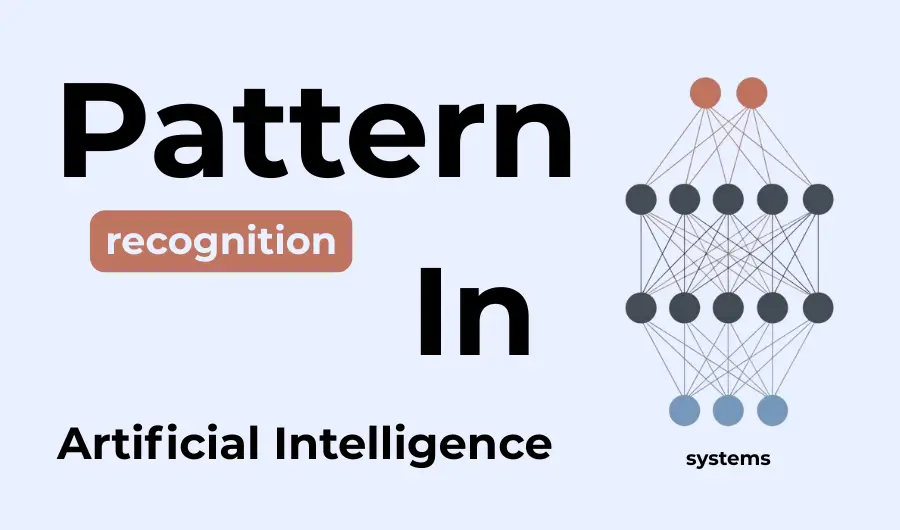
Artificial neural networks are central to modern pattern recognition. Inspired by biological neural systems, these models consist of interconnected layers of nodes that process and transmit information. Each connection carries a weight that determines its influence on the output.
Deep neural networks extend this concept by adding multiple hidden layers, allowing the system to model highly complex, non-linear relationships. This depth enables abstraction, where raw inputs are progressively transformed into meaningful representations. For example, a speech recognition model converts audio waveforms into phonetic patterns and ultimately into words.
A key property of neural networks is their ability to generalize. Rather than memorizing specific examples, they learn representations that apply to new data. This capability is essential for practical applications, where systems must operate reliably in dynamic and unpredictable environments.
Statistical Models and Probabilistic Reasoning
Beyond neural networks, many AI systems rely on probabilistic frameworks to recognize patterns. These models explicitly represent uncertainty and use probability distributions to describe relationships between variables. Techniques such as Bayesian inference allow systems to update beliefs as new data becomes available.
Probabilistic models are particularly effective in domains where data is noisy or incomplete. For instance, in natural language processing, ambiguity is inherent, and probabilistic methods help determine the most likely interpretation of a sentence. These approaches complement deterministic models by providing a principled way to handle uncertainty.
The integration of probability theory into AI reflects its statistical foundation. Pattern recognition is not about absolute certainty but about identifying the most likely structure given the available evidence.
Training Data and Generalization Limits
The effectiveness of pattern recognition depends heavily on the quality and diversity of training data. Models learn only from the examples they are exposed to, which means biases or gaps in data can directly influence outcomes. If certain patterns are underrepresented, the model may fail to recognize them accurately.
Generalization—the ability to perform well on new, unseen data—is a central challenge. Overfitting occurs when a model learns noise or specific details of the training set rather than the underlying pattern. Techniques such as regularization, cross-validation, and data augmentation are used to mitigate this risk.
Organizations such as Google and OpenAI have demonstrated that scaling both model size and dataset volume significantly improves pattern recognition capabilities. However, this scaling also introduces computational and ethical considerations, particularly regarding data sourcing and model interpretability.
Real-World Applications of Pattern Recognition
AI-driven pattern recognition underpins a wide range of real-world systems. In computer vision, models trained on datasets like ImageNet can classify objects, detect faces, and analyze scenes with high accuracy. In healthcare, pattern recognition enables the analysis of medical images, assisting in the detection of conditions such as tumors.
Natural language processing systems, including large language models, recognize patterns in text to generate coherent responses, translate languages, and summarize information. Financial institutions use pattern recognition to detect fraudulent transactions by identifying anomalies in spending behavior.
Autonomous systems, such as self-driving vehicles, rely on continuous pattern recognition to interpret sensor data and make real-time decisions. These applications illustrate how abstract mathematical processes translate into practical capabilities across industries.
Limitations and Interpretability Challenges
Despite their effectiveness, AI systems face inherent limitations in pattern recognition. Models may struggle with out-of-distribution data, where inputs differ significantly from training examples. This limitation highlights the dependency on data coverage and the difficulty of achieving true general intelligence.
Interpretability is another critical challenge. Complex models, particularly deep neural networks, often function as “black boxes,” making it difficult to understand how specific patterns are recognized or why certain decisions are made. Research in explainable AI seeks to address this issue by developing methods to make model behavior more transparent.
These challenges highlights the distinction between pattern recognition and reasoning. While AI excels at identifying statistical regularities, it does not inherently possess causal understanding or contextual awareness in the way humans do.
Conclusion
AI recognizes patterns by transforming data into numerical representations, learning statistical relationships through optimization, and generalizing these relationships to new inputs. This process is driven by mathematical models, large datasets, and iterative training techniques.
The result is a powerful capability that enables machines to interpret complex data across domains. However, the effectiveness of pattern recognition remains bounded by data quality, model design, and the inherent limitations of statistical inference.
AI Informed Newsletter
Stay informed on the fastest growing technology.
Disclaimer: The content on this page and all pages are for informational purposes only. We use AI to develop and improve our content — we love to use the tools we promote.
Course creators can promote their courses with us and AI apps Founders can get featured mentions on our website, send us an email.
Simplify AI use for the masses, enable anyone to leverage artificial intelligence for problem solving, building products and services that improves lives, creates wealth and advances economies.
A small group of researchers, educators and builders across AI, finance, media, digital assets and general technology.
If we have a shot at making life better, we owe it to ourselves to take it. Artificial intelligence (AI) brings us closer to abundance in health and wealth and we're committed to playing a role in bringing the use of this technology to the masses.
We aim to promote the use of AI as much as we can. In addition to courses, we will publish free prompts, guides and news, with the help of AI in research and content optimization.
We use cookies and other software to monitor and understand our web traffic to provide relevant contents, protection and promotions. To learn how our ad partners use your data, send us an email.
© newvon | all rights reserved | sitemap