

What is Unsupervised Learning?
Unsupervised learning is a machine learning method that discovers patterns and structure in unlabeled data without predefined outcomes.
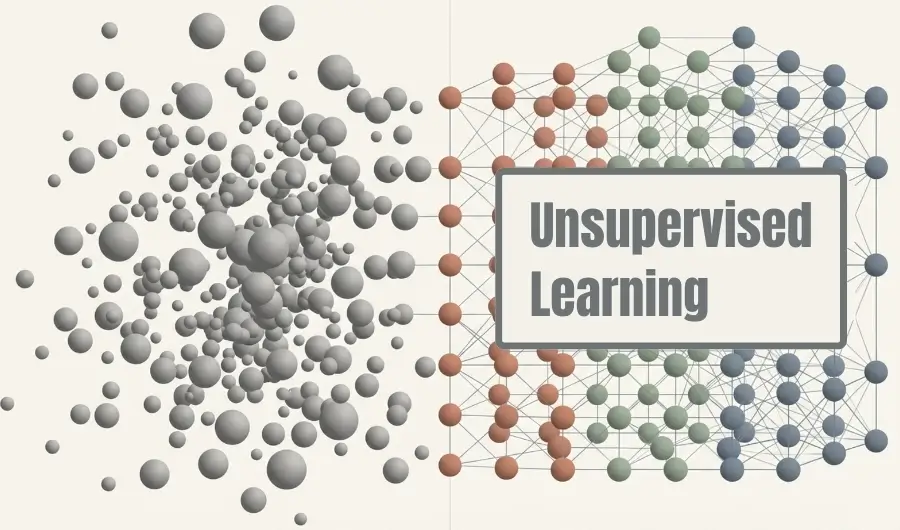
Understanding Unsupervised Learning
Unsupervised learning is a branch of Machine Learning in which algorithms analyze datasets that contain no labeled outputs. Unlike supervised learning systems that rely on explicitly labeled examples, unsupervised models infer relationships, patterns, and underlying structures directly from the input data. The objective is not to predict a known target variable but to identify meaningful organization within complex datasets.
In practical terms, an unsupervised learning system receives raw input data and attempts to determine how the data points relate to one another. Because there is no labeled training signal, the algorithm must rely on statistical properties such as similarity, density, or distribution to construct internal representations of the data. This ability makes unsupervised learning particularly useful for exploring large or poorly understood datasets where predefined categories are unavailable.
The conceptual foundation of unsupervised learning is grounded in statistical pattern discovery. Many of the mathematical techniques used by these algorithms draw from fields such as Statistics, Information Theory, and Data Mining. These disciplines provide the theoretical basis for measuring similarity, identifying clusters, and compressing high-dimensional information into interpretable structures.
Core Objectives of Unsupervised Learning
The primary purpose of unsupervised learning is to reveal hidden organization within data. Because the data lacks labels or predefined outcomes, the algorithm attempts to discover natural groupings, detect anomalies, or construct lower-dimensional representations that preserve important characteristics of the original dataset.
One major objective is clustering, which involves grouping similar data points together based on statistical similarity. Clustering algorithms measure the distance between observations and organize them into clusters so that points within the same cluster are more similar to each other than to points in other clusters. This process enables systems to identify natural categories in datasets without human-defined labels.
Another important objective is dimensionality reduction. Many real-world datasets contain thousands or even millions of features, making analysis computationally difficult. Dimensionality reduction techniques simplify these datasets by projecting them into lower-dimensional spaces while preserving essential relationships. This approach not only improves computational efficiency but also helps researchers visualize complex data structures.
Unsupervised learning is also widely used for anomaly detection. In this context, algorithms identify observations that deviate significantly from the dominant data patterns. These deviations can represent rare events, errors, or unusual behaviors that warrant further investigation.
Clustering as a Central Technique
Clustering represents one of the most widely applied forms of unsupervised learning. The goal of clustering algorithms is to partition data into groups whose members share similar characteristics according to a defined distance metric.
One of the most well-known clustering algorithms is K-means clustering. K-means partitions a dataset into a predetermined number of clusters by iteratively assigning points to cluster centers and adjusting those centers to minimize within-cluster variance. The algorithm was formally introduced in the 1967 paper “Some Methods for Classification and Analysis of Multivariate Observations” by James MacQueen.
Another influential clustering method is DBSCAN (Density-Based Spatial Clustering of Applications with Noise), introduced in 1996 by Martin Ester and colleagues at the Ludwig Maximilian University of Munich. DBSCAN identifies clusters by locating regions of high point density and separating them from sparse areas, allowing the algorithm to discover clusters of irregular shape while also detecting outliers.
Clustering techniques are widely used in domains such as market segmentation, biological data analysis, and document organization, where the inherent structure of the dataset is unknown before analysis.
Dimensionality Reduction and Data Representation
Dimensionality reduction is another core capability of unsupervised learning. These techniques transform high-dimensional datasets into smaller representations that retain the most important information.
One of the earliest and most widely used methods is Principal Component Analysis (PCA). PCA was formally introduced by Karl Pearson in 1901 and later generalized by Harold Hotelling in 1933. The technique identifies directions in the dataset, known as principal components, along which the variance of the data is maximized. By projecting the data onto these components, PCA compresses the dataset while preserving its most significant patterns.
Dimensionality reduction techniques are particularly valuable when working with high-dimensional data such as images, genomic information, or sensor signals. By reducing complexity, these methods enable more efficient analysis and often reveal latent structures that are difficult to detect in the original representation.
Association Pattern Discovery
Unsupervised learning also includes algorithms designed to uncover relationships between variables within a dataset. These methods are commonly referred to as association rule learning.
A widely recognized algorithm in this category is the Apriori algorithm, developed by Rakesh Agrawal and Ramakrishnan Srikant at IBM in 1994. Apriori identifies frequently occurring combinations of items within transactional datasets and derives rules that describe how those items are associated.
Association rule learning became widely known through retail analytics, where companies analyze purchase transactions to determine which products are frequently bought together. This type of pattern discovery enables organizations to understand behavioral relationships within large collections of events or transactions.
Applications in Modern Artificial Intelligence
Unsupervised learning plays an essential role in modern Artificial Intelligence because much of the world’s data is unlabeled. Creating labeled datasets requires significant human effort, making unsupervised methods particularly valuable for large-scale analysis.
In natural language processing, unsupervised learning techniques are used to identify semantic relationships between words and documents. Systems trained on large text corpora can automatically discover linguistic patterns that capture similarities in meaning. These representations form the foundation for many modern language technologies.
Computer vision also benefits from unsupervised learning methods that extract visual features from raw image data. By analyzing patterns in pixel distributions, algorithms can learn representations that capture shapes, textures, and spatial relationships without manual annotation.
Large-scale technology companies actively apply these methods in production systems. For example, Google and Meta Platforms use unsupervised or self-supervised learning techniques to analyze massive datasets of images, text, and user interactions in order to build scalable AI models.
Distinguishing Unsupervised Learning from Supervised Learning
A clear conceptual distinction exists between unsupervised learning and supervised learning. Supervised learning algorithms train on labeled datasets in which each input is paired with a known output. The model learns a mapping function that predicts the output for new inputs.
Unsupervised learning, by contrast, operates without labeled outputs. Instead of predicting predefined categories or numerical targets, the algorithm focuses on discovering intrinsic structure within the data itself. The result is typically a representation of the dataset, such as clusters, latent variables, or compressed feature spaces.
This distinction influences both the design of algorithms and the types of problems each approach addresses. Supervised learning excels at prediction tasks, while unsupervised learning is primarily used for exploration, pattern discovery, and data representation.
Limitations and Challenges
Despite its versatility, unsupervised learning presents several technical challenges. One major difficulty is the absence of a definitive evaluation signal. Because the dataset lacks labeled outcomes, it can be difficult to determine whether the patterns discovered by the algorithm are meaningful or merely artifacts of the data.
Another challenge involves interpretability. Some unsupervised models produce complex mathematical representations that are difficult for humans to interpret directly. Researchers must often combine statistical analysis with domain expertise to determine whether the discovered structures correspond to real-world phenomena.
Computational complexity can also become a constraint when analyzing extremely large datasets. Many unsupervised algorithms require iterative optimization processes that become expensive as dataset size increases.
The Role of Unsupervised Learning in Data Science
Within the discipline of Data Science, unsupervised learning is widely used during exploratory data analysis. Before building predictive models, analysts frequently apply clustering or dimensionality reduction techniques to understand the basic structure of a dataset.
This exploratory process can reveal hidden relationships between variables, identify redundant features, and detect anomalies that might distort further analysis. By uncovering these patterns early, unsupervised learning helps guide the design of subsequent machine learning workflows.
The importance of unsupervised learning continues to grow as the volume of global data expands. Since most real-world data is unlabeled, algorithms capable of discovering structure without manual annotation remain essential tools in the development of scalable intelligent systems.
AI Informed Newsletter
Stay informed on the fastest growing technology.
Disclaimer: The content on this page and all pages are for informational purposes only. We use AI to develop and improve our content — we love to use the tools we promote.
Course creators can promote their courses with us and AI apps Founders can get featured mentions on our website, send us an email.
Simplify AI use for the masses, enable anyone to leverage artificial intelligence for problem solving, building products and services that improves lives, creates wealth and advances economies.
A small group of researchers, educators and builders across AI, finance, media, digital assets and general technology.
If we have a shot at making life better, we owe it to ourselves to take it. Artificial intelligence (AI) brings us closer to abundance in health and wealth and we're committed to playing a role in bringing the use of this technology to the masses.
We aim to promote the use of AI as much as we can. In addition to courses, we will publish free prompts, guides and news, with the help of AI in research and content optimization.
We use cookies and other software to monitor and understand our web traffic to provide relevant contents, protection and promotions. To learn how our ad partners use your data, send us an email.
© newvon | all rights reserved | sitemap